
Those were not days of mobile and E mail- My experience of reporting Narwana hooch tragedy in eighties for Indian Express.
Gustakhi Maaf Haryana- Pawan Kumar Bansal.
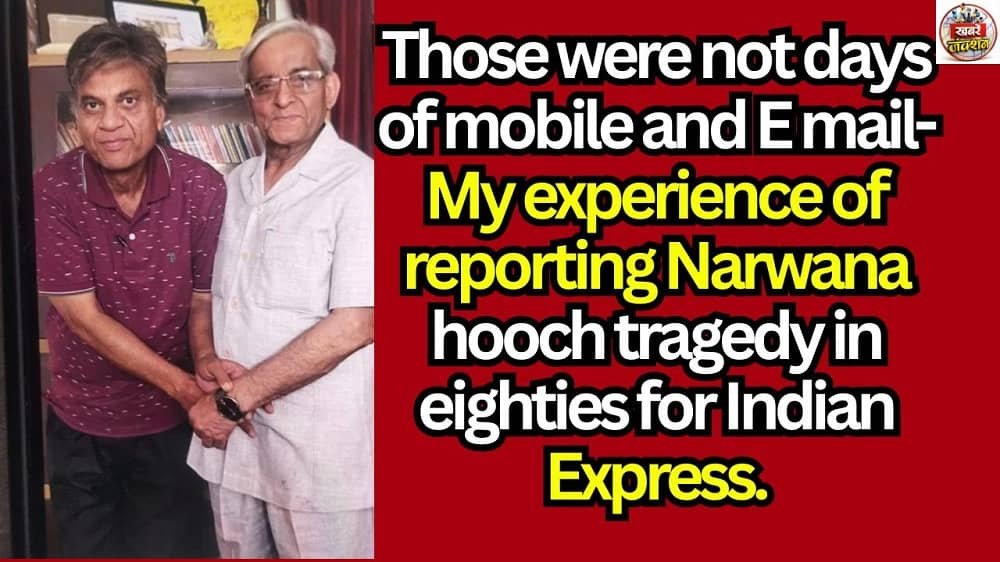
A meeting with former Resident Editor of The Indian Express, Mr. P. K. Modi, brought back a flood of old memories. I was reminded of the time when I began my career in journalism as a stringer in Jind, while Mr. Modi was our News Editor in Chandigarh, and Mr. Prabhash Joshi served as the Resident Editor.
In the early 1980s, hundreds of people lost their lives and many others were left blind after consuming spurious liquor—an incident that came to be known as the Narwana hooch tragedy. Those were not the days of email or mobile phones. Reports sent from Narwana would reach our Chandigarh office late in the evening through the Morse system of the Posts and Telegraph Department.
As a result, I would travel daily by bus from Narwana to Chandigarh and return by taxi, often carrying bundles of newspapers. On one occasion, the office sent the then Chandigarh reporter, Shekhar Gupta, by taxi to cover the story in Narwana, while I reached the office by bus. It was a testament to Mr. Joshi’s generosity and fairness that my story was also published.
In the biting cold of December, I often travelled sitting atop bundles of newspapers. What motivated me was seeing my reports appear on the front page in the postal edition of the newspaper, carrying my byline.
Today, technology has advanced to the point where news can be transmitted across the world in seconds. Unfortunately, however, editorial courage seems to have diminished, and investigative journalism is gradually disappearing