
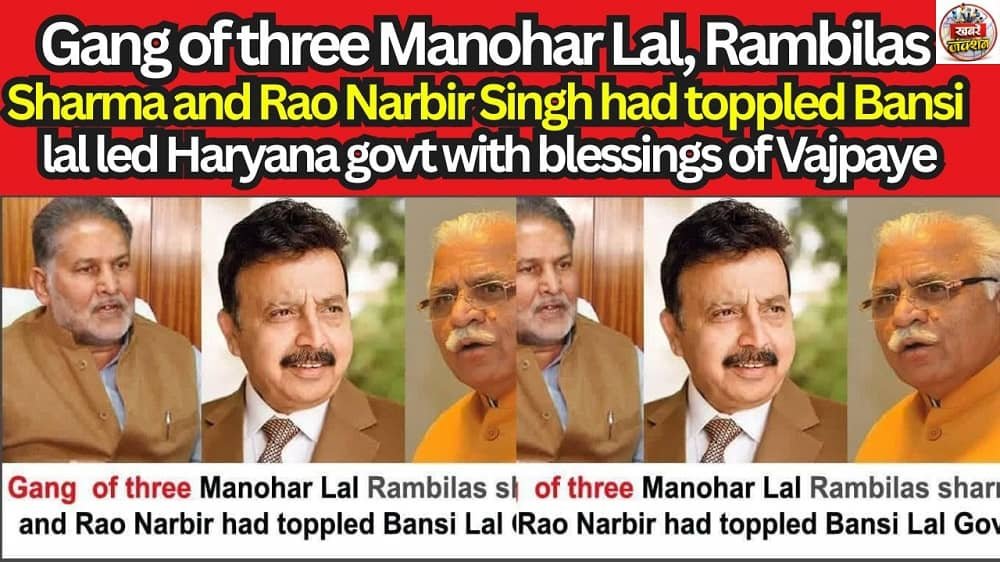
Gang of three Manohar Lal, Rambilas Sharma and Rao Narbir Singh had toppled Bansi lal led Haryana govt with blessings of Vajpaye
Gustakhi Maaf Haryana -Pawan Kumar Bansal.
Extracts from my forthcoming book “Murky Politics of Haryana”
It was a matter of shame that while India’s jawans were laying down their lives in Kargil, the Haryana Vikas Party (HVP)–BJP coalition government headed by Bansi Lal was toppled in Haryana with the blessings of Atal Bihari Vajpayee and the support of disgruntled HVP MLAs.
The trio of Manohar Lal Khattar, Rao Narbir Singh and Ram Bilas Sharma played a key role in this ugly political drama. Each had his own personal grievance against Bansi Lal.
About twenty-seven years ago, the BJP helped bring down the Bansi Lal government in Haryana with the backing of rebel MLAs from his own party and the blessings of Vajpayee. Shockingly, the entire operation was scripted and executed when the country was still dealing with the aftermath of the Kargil War.
In the 1996 Assembly elections, the HVP and BJP had contested as pre-poll alliance partners, leading to the formation of a government headed by Bansi Lal, with nearly half a dozen BJP ministers in the Cabinet.
However, within three years, Krishna Gehlot, Karan Dalal, Rao Narbir Singh and Brij Mohan Singla revolted against Bansi Lal’s style of functioning. BJP legislators supported the rebellion, reducing the government to a minority and paving the way for a government headed by Om Prakash Chautala.
Vajpayee and Advani on Opposite Sides
The BJP high command itself was sharply divided over the issue. Vajpayee reportedly supported the move, while Lal Krishna Advani and Sushma Swaraj opposed it.
During the 1996 Assembly elections, Chautala too was keen on aligning with the BJP. However, Sushma Swaraj ensured that the alliance was forged with Bansi Lal’s HVP instead. After becoming Chief Minister, Bansi Lal reciprocated the gesture by facilitating the election of Swaraj Kaushal to the Rajya Sabha from Haryana.
At that time, Ram Bilas Sharma was a minister, while present Union Minister Manohar Lal Khattar was serving as the state BJP’s organising secretary. Both allegedly played major roles in the toppling exercise.
Ram Bilas Sharma was reportedly nurturing ambitions of becoming Chief Minister after being told by a self-styled godman that he had bright chances of occupying the post. Manohar Lal, too, was unhappy because Bansi Lal was allegedly not giving him adequate importance within the alliance.
Rao Narbir Singh also had his own reasons for resentment. His Food and Supplies portfolio had been changed following a report written by this author in Jansatta, alleging irregularities in the grant of brick-kiln licences in violation of environmental norms.
Thus, the trio, driven by their individual agendas, brought down the government.
Did Our Jawans Die for This?
Deeply disturbed by the ugly spectacle of horse-trading, Akshya Gupta wrote a powerful letter to the editor of The Tribune, Chandigarh:
“Everyone with even a little conscience would have felt pained by the recent round of horse-trading during the formation of the government. That this should happen at a time when the country was still coping with the aftermath of the Kargil battle should make us hang our heads in shame.
Are these the people for whom our brave jawans made the supreme sacrifice? The immense personal loss suffered by many families — some of whom lost their only earning member in the mountains of Kargil — appears to have gone in vain.
Our Army was defending the motherland. But within that motherland are self-serving politicians who have nothing to lose and everything to gain during their brief stay in power.
What kind of role models are they setting for the youth and the common man?
Even the mules of Kargil are better than these new horses of Haryana politics.”
To be continued…