
The Editorial Ombudsman and Student,s suicides at NIT Kurukshetra
Gustakhi Maaf Haryana-Pawan Kumar Bansal
By our enlightened reader Dr Ranbir Singh Phaugat.The Editorial Ombudsman and Student Suicides at NIT Kurukshetra
It has been quite some time since the intellectual pages of prestigious newspapers—specifically the editorial page and the page dedicated to supplementary articles (known in English as the “Editorial and Opinion Pages”)—regularly featured reviews and critiques by enlightened editors regarding news reports and features that had appeared in their very own newspapers just a week earlier.
This role was akin to that of an internal reviewer, inspector, or adjudicator—a function that could be aptly termed, in English, as the “Internal Editorial Ombudsman.” There was no need to conduct a weekly review of all material published in the newspaper, as, from a human perspective, such a task would be a tedious and labor-intensive intellectual undertaking. Consequently, the Editorial Ombudsman would select a representative sample of articles and news reports to scrutinize their structure, identify any superfluous or extraneous content, and conduct an impartial linguistic and factual verification, while also offering a comparative analysis of their underlying meanings.
Articles stemming from the studies and intellectual interventions of the Editorial Ombudsman used to be published regularly every week in the English daily newspaper The Hindu; however, their publication appears to have ceased—perhaps for the last two years. Whether something happened to the Editorial Ombudsman personally, or if this was the result of a policy decision, I have absolutely no information regarding the matter.
A second avenue for such engagement opens up from the perspective of the reader. Most newspapers across the country have discontinued their “Letters to the Editor” column, deeming it an unnecessary appendage. Those that have chosen to retain it do so because they prioritize a “Public Service” ethos as a fundamental value. The economic viability of newspapers suffered a severe blow due to the COVID-19 pandemic and the rise of digital journalism, resulting in their total revenue—derived from advertising and copy sales—being slashed by half. Some publications responded by reducing their staff headcount and the number of pages in their daily editions, while other measures were also implemented to help stabilize their financial standing. When it comes to the role of an Editorial Ombudsman and the maintenance of journalistic standards, the situation is most dire among Hindi newspapers.
This is largely because their editors and sub-editors tend to overlook certain issues, while the proprietors remain indifferent—as the majority of them are concerned solely with the profit figures reflected in their balance sheets. While not everything is entirely bleak, every newspaper requires a knowledgeable guardian—The Editorial Ombudsman and Student Suicides at NIT Kurukshetra
It has been quite some time since the intellectual pages of prestigious newspapers—specifically the editorial page and the page dedicated to supplementary articles (known in English as the “Editorial and Opinion Pages”)—regularly featured reviews and critiques by enlightened editors regarding news reports and features that had appeared in their very own newspapers just a week earlier. This role was akin to that of an internal reviewer, inspector, or adjudicator—a function that could be aptly termed, in English, as the “Internal Editorial Ombudsman.” There was no need to conduct a weekly review of all material published in the newspaper, as, from a human perspective, such a task would be a tedious and labor-intensive intellectual undertaking.
Consequently, the Editorial Ombudsman would select a representative sample of articles and news reports to scrutinize their structure, identify any superfluous or extraneous content, and conduct an impartial linguistic and factual verification, while also offering a comparative analysis of their underlying meanings. Articles stemming from the studies and intellectual interventions of the Editorial Ombudsman used to be published regularly every week in the English daily newspaper The Hindu; however, their publication appears to have ceased—perhaps for the last two years. Whether something happened to the Editorial Ombudsman personally, or if this was the result of a policy decision, I have absolutely no information regarding the matter.
A second avenue for such engagement opens up from the perspective of the reader. Most newspapers across the country have discontinued their “Letters to the Editor” column, deeming it an unnecessary appendage. Those that have chosen to retain it do so because they prioritize a “Public Service” ethos as a fundamental value. The economic viability of newspapers suffered a severe blow due to the COVID-19 pandemic and the rise of digital journalism, resulting in their total revenue—derived from advertising and copy sales—being slashed by half.
Some publications responded by reducing their staff headcount and the number of pages in their daily editions, while other measures were also implemented to help stabilize their financial standing. When it comes to the role of an Editorial Ombudsman and the maintenance of journalistic standards, the situation is most dire among Hindi newspapers. This is largely because their editors and sub-editors tend to overlook certain issues, while the proprietors remain indifferent—as the majority of them are concerned solely with the profit figures reflected in their balance sheets.
While not everything is entirely bleak, every newspaper requires a knowledgeable guardian—an intellectual overseer—to monitor this critical sphere of activity. Such a figure, drawing upon their own expertise and carefully sifting through the reader correspondence received at the editorial office, could identify pertinent insights that would progressively enrich the intellectual environment of the editorial staff.
Figures such as N. Ravi of The Hindu; the editorial team at Jansatta during the era of Prabhash Joshi; editors—including the distinguished Prem Bhatia—at The Tribune (Punjab’s oldest English daily); and, at one time, the editors of Nai Duniya (published from Indore) and Karpoor Chand Kulish of Rajasthan Patrika—along with a few editors of English and vernacular newspapers published from Bombay, Bhopal, and Bengaluru (whose names I have since forgotten)—stood as exemplary models of knowledgeable and linguistically responsible journalism right up until 1990.
The English-language daily The Tribune was originally published from Lahore; however, following the Partition of India in 1947, it was published briefly from Ambala. Once a permanent headquarters was established in Chandigarh, it has been published regularly from that location ever since. I had the privilege of attending two lengthy lectures delivered by The Tribune’s renowned editor, Mr. Prem Bhatia, in which he detailed his own daily routine within the newspaper’s editorial office and outlined the expectations he held for his correspondents working in the field. I read his memoir, All My Yesterdays (1973), back in 1980.
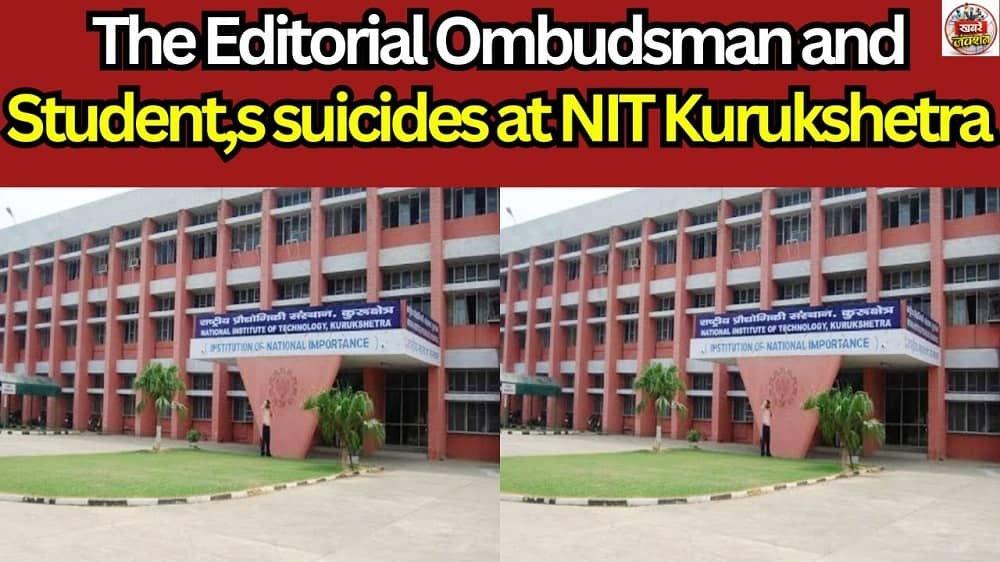
That kind of environment no longer exists today; neither the writers nor the majority of editors remain research-oriented in their approach. Yesterday, on April 20, 2026, a short article titled ‘Why Are Youth Losing in This Kurukshetra?’ appeared on the ‘Opinion’ page of Amar Ujala (Haryana), authored by Vijay Kumar Gupta. This piece serves as a commentary regarding the cases of student suicides at the National Institute of Technology, located on the outskirts of Kurukshetra city. At first glance, the article appears unexceptionable; however, when viewed through the lens of a Public Ombudsman, certain elements warrant specific comment.
The article requires careful reading. The author states that the four suicides committed by students within a span of two months constitute a ‘sign of a grave systemic failure.’ A subsequent line notes that ‘questions loom over the insensitive mechanism that failed to recognize the warning signs in time.’ It further observes that ‘in all four cases, no clear motive for the suicide has yet emerged.’ Adopting an accusatory tone, the author alleges that ‘the administration confined itself merely to procedural formalities’ and that ‘the institute failed to demonstrate any seriousness regarding the investigation.’ The piece concludes by stating that ‘the consequence of ignoring these warnings manifested on April 16 in the form of yet another lost life.’ A close reading of the article reveals that the initial descriptive passages appear to have been written in haste, although the subsequent text—in terms of analysis and commentary—remains sound.
Many of the statements contained within the article are ‘impressionistic’—that is, they are speculative in nature and not grounded in concrete evidence. While no institution typically shares confidential reports with journalists, had such a report existed—and had it either not been requested by the author or been withheld upon request—this fact ought to have been explicitly mentioned in the article. Furthermore, today marks the fifth day since April 16—the date of the fourth and most recent suicide incident—and on April 20, high-ranking officials from the relevant Union Government ministry visited the institute and held interactions with students and other stakeholders; yet, neither the Hindi nor the English press has published a single report detailing the activities or observations of the visiting officials.
What information did the officials gather? They likely did not wish to speak to the press and presumably reached a consensus that, upon returning to Delhi, they would compile a report and submit it to higher-ranking authorities. Let them do as they please. There are two words in English: empathy and callousness. I feel that the system is utterly irresponsible; students have lost their lives, yet why is there such secrecy surrounding the circumstances of these tragic events? Nowadays, students in higher educational institutions are subjected to immense psychological cruelty.
They are humiliated and overwhelmed—burdened by new technologies (particularly cutting-edge Artificial Intelligence and IT), as well as by the sheer weight of their academic syllabi. Studying technology is not akin to studying dynastic history, novels, or Hindi literature—which often involves stories and poetry—but rather demands an exceptionally high level of intellectual aptitude. Young students, living far removed from the protective care of their parents and siblings, often find themselves unable to cope with these pressures within the confines of a hostel environment. Although single occupancy rooms are rarely allotted in hostels these days—students are typically assigned shared rooms (two per room) to ensure immediate assistance and safety—a student sharing a room may still find themselves alone at times. It is during such moments of solitude that they may be driven to take drastic measures.
It does not appear that any psychologist has ever visited NIT Kurukshetra, nor does it seem that anyone has ever scrutinized the attitude and conduct of the teaching staff there. There could be not just one, but dozens of underlying causes behind the suicides of these four students; furthermore, I do not believe that the official inquiry reports will yield any meaningful results.
Such inquiries often serve merely as a charade—a bureaucratic eyewash—in which the actual culprits are shielded, while the blame is conveniently shifted onto the nebulous “atmosphere” or “environment.” Now, how exactly can one mete out punishment to an “atmosphere”—an abstract, intangible entity?
In any case, regardless of the specifics, the news reports concerning this matter—published in both Hindi and English over the past few days—lack any real substance or depth. They appear to be nothing more than a perfunctory exercise in fulfilling bureaucratic formalities. intellectual overseer—to monitor this critical sphere of activity.
Such a figure, drawing upon their own expertise and carefully sifting through the reader correspondence received at the editorial office, could identify pertinent insights that would progressively enrich the intellectual environment of the editorial staff.
Figures such as N. Ravi of The Hindu; the editorial team at Jansatta during the era of Prabhash Joshi; editors—including the distinguished Prem Bhatia—at The Tribune (Punjab’s oldest English daily); and, at one time, the editors of Nai Duniya (published from Indore) and Karpoor Chand Kulish of Rajasthan Patrika—along with a few editors of English and vernacular newspapers published from Bombay, Bhopal, and Bengaluru (whose names I have since forgotten)—stood as exemplary models of knowledgeable and linguistically responsible journalism right up until 1990. The English-language daily The Tribune was originally published from Lahore; however, following the Partition of India in 1947, it was published briefly from Ambala. Once a permanent headquarters was established in Chandigarh, it has been published regularly from that location ever since.
I had the privilege of attending two lengthy lectures delivered by The Tribune’s renowned editor, Mr. Prem Bhatia, in which he detailed his own daily routine within the newspaper’s editorial office and outlined the expectations he held for his correspondents working in the field. I read his memoir, All My Yesterdays (1973), back in 1980.
That kind of environment no longer exists today; neither the writers nor the majority of editors remain research-oriented in their approach. Yesterday, on April 20, 2026, a short article titled ‘Why Are Youth Losing in This Kurukshetra?’ appeared on the ‘Opinion’ page of Amar Ujala (Haryana), authored by Vijay Kumar Gupta. This piece serves as a commentary regarding the cases of student suicides at the National Institute of Technology, located on the outskirts of Kurukshetra city. At first glance, the article appears unexceptionable; however, when viewed through the lens of a Public Ombudsman, certain elements warrant specific comment.
The article requires careful reading. The author states that the four suicides committed by students within a span of two months constitute a ‘sign of a grave systemic failure.’ A subsequent line notes that ‘questions loom over the insensitive mechanism that failed to recognize the warning signs in time.’ It further observes that ‘in all four cases, no clear motive for the suicide has yet emerged.’ Adopting an accusatory tone, the author alleges that ‘the administration confined itself merely to procedural formalities’ and that ‘the institute failed to demonstrate any seriousness regarding the investigation.’ The piece concludes by stating that ‘the consequence of ignoring these warnings manifested on April 16 in the form of yet another lost life.’ A close reading of the article reveals that the initial descriptive passages appear to have been written in haste, although the subsequent text—in terms of analysis and commentary—remains sound.
Many of the statements contained within the article are ‘impressionistic’—that is, they are speculative in nature and not grounded in concrete evidence.
While no institution typically shares confidential reports with journalists, had such a report existed—and had it either not been requested by the author or been withheld upon request—this fact ought to have been explicitly mentioned in the article. Furthermore, today marks the fifth day since April 16—the date of the fourth and most recent suicide incident—and on April 20, high-ranking officials from the relevant Union Government ministry visited the institute and held interactions with students and other stakeholders; yet, neither the Hindi nor the English press has published a single report detailing the activities or observations of the visiting officials.
What information did the officials gather? They likely did not wish to speak to the press and presumably reached a consensus that, upon returning to Delhi, they would compile a report and submit it to higher-ranking authorities. Let them do as they please. There are two words in English: empathy and callousness.
I feel that the system is utterly irresponsible; students have lost their lives, yet why is there such secrecy surrounding the circumstances of these tragic events? Nowadays, students in higher educational institutions are subjected to immense psychological cruelty. They are humiliated and overwhelmed—burdened by new technologies (particularly cutting-edge Artificial Intelligence and IT), as well as by the sheer weight of their academic syllabi. Studying technology is not akin to studying dynastic history, novels, or Hindi literature—which often involves stories and poetry—but rather demands an exceptionally high level of intellectual aptitude.
Young students, living far removed from the protective care of their parents and siblings, often find themselves unable to cope with these pressures within the confines of a hostel environment. Although single occupancy rooms are rarely allotted in hostels these days—students are typically assigned shared rooms (two per room) to ensure immediate assistance and safety—a student sharing a room may still find themselves alone at times. It is during such moments of solitude that they may be driven to take drastic measures.
It does not appear that any psychologist has ever visited NIT Kurukshetra, nor does it seem that anyone has ever scrutinized the attitude and conduct of the teaching staff there. There could be not just one, but dozens of underlying causes behind the suicides of these four students; furthermore, I do not believe that the official inquiry reports will yield any meaningful results.
Such inquiries often serve merely as a charade—a bureaucratic eyewash—in which the actual culprits are shielded, while the blame is conveniently shifted onto the nebulous “atmosphere” or “environment.” Now, how exactly can one mete out punishment to an “atmosphere”—an abstract, intangible entity?
In any case, regardless of the specifics, the news reports concerning this matter—published in both Hindi and English over the past few days—lack any real substance or depth. They appear to be nothing more than a perfunctory exercise in fulfilling bureaucratic formalities.