
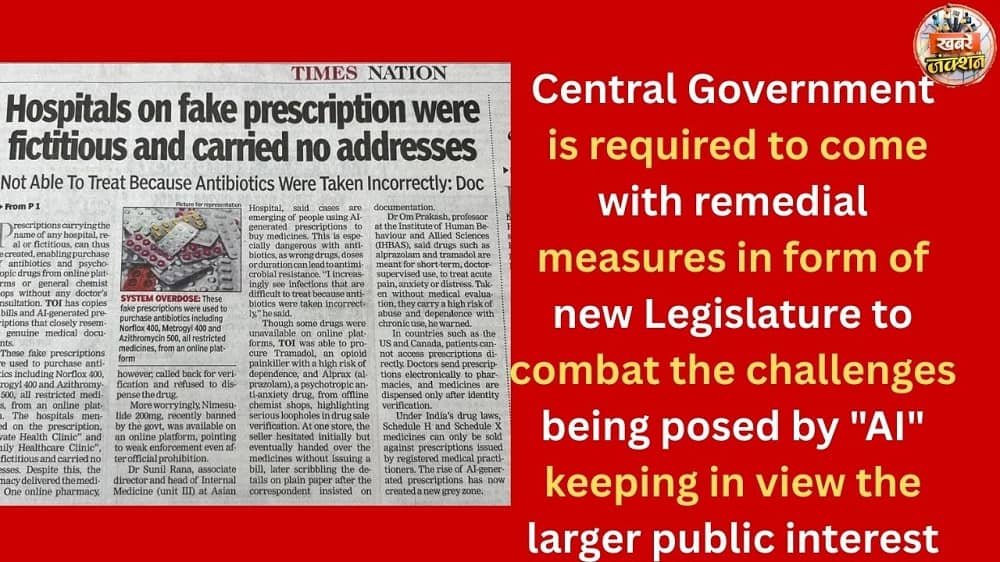
Central Government is required to come with remedial measures in form of new Legislature to combat the challenges being posed by “AI” keeping in view the larger public interest
Gustakhi Maaf Haryana – Pawan Kumar Bansal
By our enlightened reader: G. L. Singal, Retired Drug Controller, Haryana
Rule 65 of the Drugs and Cosmetics Rules, 1945 mandates that the sale and supply of Schedule H and H-1 medicines shall be only on the prescription of a Registered Medical Practitioner (RMP), meaning these medicines are not Over-The-Counter (OTC) drugs.
Drugs including antibiotics, narcotics, psychotropic substances, and other highly potent and sensitive medicines are included under Schedule H/H-1. This list is dynamic in nature.
The legislative intent is to prevent self-medication of such highly potent and sensitive drugs, which can result in serious adverse effects and even fatality if used without proper medical advice.
There is yet another category of drugs included under Schedule X, the dispensing of which requires a prescription in duplicate from an RMP, in order to further tighten control and prevent misuse of such drugs.
Many psychotropic drugs such as Buprenorphine, Alprazolam, Clonazepam, Diazepam, Tramadol, etc., as their category suggests, impact the brain and are openly misused for addiction purposes in our society. Our youth is the easiest target and victim due to their tender age and various socio-economic factors.
To curb such addictive malpractices, the Government is taking appropriate steps to check the easy availability and misuse of these drugs, which are proving fatal to the younger population. This is being done through enactment of new legislation (NDPS Act, 1985), amendments to existing laws, and by imposing various restrictions. Many drugs which were earlier not covered under the NDPS Act have now been brought under its purview, and this process is continuing.
Regulatory agencies in India, such as the Police, Narcotics Bureau, and Drug Control Regulators, are struggling hard to achieve the objectives of their respective legislations (Drugs & Cosmetics Act, 1940 and NDPS Act, 1985) through strict enforcement with zero tolerance. However, success still appears distant.
“Artificial Intelligence” (AI), a 21st-century innovation, has now emerged as another major bottleneck, undermining the efforts of government regulatory agencies in curbing the misuse of habit-forming drugs, due to the easy availability of AI-generated prescriptions. As a result, addicts can now freely obtain such prescription drugs legally from chemists and online pharmacies.
It would not be incorrect to state that even after nearly nine decades of the Drugs & Cosmetics Act, 1940 and four decades of the NDPS Act, 1985, we have yet to fully achieve the intended objectives of these Acts. Now, another challenge stands ready to further disturb the regulatory framework.
Therefore, as a visionary step, the Central Government is required to introduce remedial measures in the form of new legislation to combat the challenges posed by Artificial Intelligence, keeping in view the larger public interest.
khabre junction