
Youth Should Enter Politics Grounded in Values and Propriety
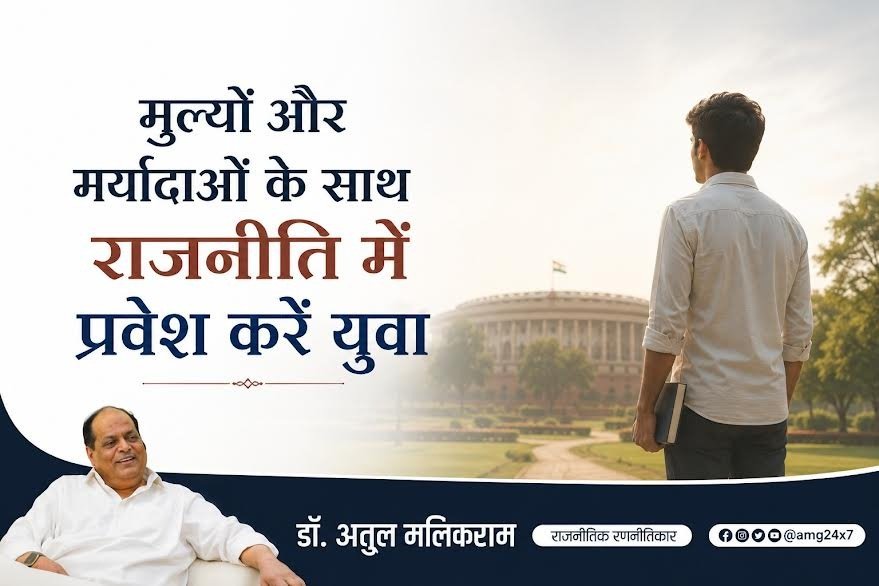
- — Dr. Atul Malikram (Political Strategist)
India is currently one of the youngest nations in the world. A significant portion of the country’s population falls within the 18-to-35 age group. This demographic not only embodies the nation’s energy and potential but also constitutes the most crucial social group for shaping the future. Given this, the question naturally arises: should the youth enter politics? It is my firm belief that young people should indeed enter politics; however, a positive mindset, democratic values, and exemplary conduct must be the prerequisites for doing so.
Politics is not merely a means to acquire office or power; it is the most effective platform for nation-building and societal development. Unfortunately, the image of politics projected to the youth in recent years has deterred many talented young individuals from this field. Rising bitterness in public life, personal recriminations, questions regarding character, and instances of unnecessary confrontation breed skepticism about politics in the minds of the youth. Yet, it remains true that the entry of good people into a system is essential for its improvement.
Today, issues such as education, employment, healthcare, technology, the environment, and entrepreneurship directly impact the lives of young people. The greater the youth participation in forums where policies regarding these issues are formulated, the more relevant and effective the decisions will be. Therefore, the active presence of youth in politics is not just a necessity but is vital for strengthening democracy.
Young people bring fresh thoughts, new energy, and a capacity for innovation. They view change as an opportunity and offer novel perspectives to solve problems. This is why political participation by the youth is being encouraged in many democratic nations across the globe. In India, too, the need of the hour is for the youth not to remain mere voters but to play an active role in the policy-making process.
However, it is crucial for young people entering politics to understand that the foundation of success in public life is credibility, not merely popularity. A leader’s true identity is defined by their character, conduct, and commitment to the public. Only those who walk the path of respect, dialogue, and service can sustain the public’s trust over the long term.
Great leaders like Mahatma Gandhi, Sardar Vallabhbhai Patel, and Dr. Bhimrao Ambedkar guided society through their ideas, actions, and ethical leadership. They demonstrated that enduring leadership is built not on displays of power, but on principles and public service. This should serve as the greatest inspiration for today’s youth. Young people entering politics should first work at the grassroots level. Understanding local issues, engaging in dialogue with the public, and participating in initiatives for the social good constitute the first school of leadership. Public trust is earned not through speeches, but through consistent work and sensitivity.
Alongside this, education and awareness are crucial. A young leader should develop an understanding of the Constitution, administration, law, the economy, and current trends. Only leadership grounded in knowledge is capable of making visionary decisions. In the digital age, social media is a powerful medium, but it must be used responsibly and authentically. Furthermore, transparency and honesty hold special significance in politics. Today’s public is more aware than ever and expects accountability from its representatives; therefore, young leaders must maintain clarity in their actions and decisions. Trust is the greatest asset of leadership.
Discipline, dialogue, and respect are also essential qualities of leadership. Differences of opinion are a natural part of democracy, but turning disagreement into hostility is detrimental to democratic culture. A mature leader is one who maintains a respectful attitude toward both supporters and opponents. India’s future will be shaped not merely by new technologies or policies, but by a young leadership that makes ethics, service, and responsibility the foundation of its public life. If politics is to become a vehicle for nation-building, the youth must step forward and prove that leadership means not just holding power, but also dedicating oneself to society.
Today, there is a need for young people who carve out an identity for themselves through impactful personalities, positive thinking, and acts of public service. When the youth enter politics upholding values, decorum, and exemplary conduct, democracy will be further strengthened, and India’s development will gain new momentum. This is the path that leads the youth towards successful, respected, and popular leadership.