
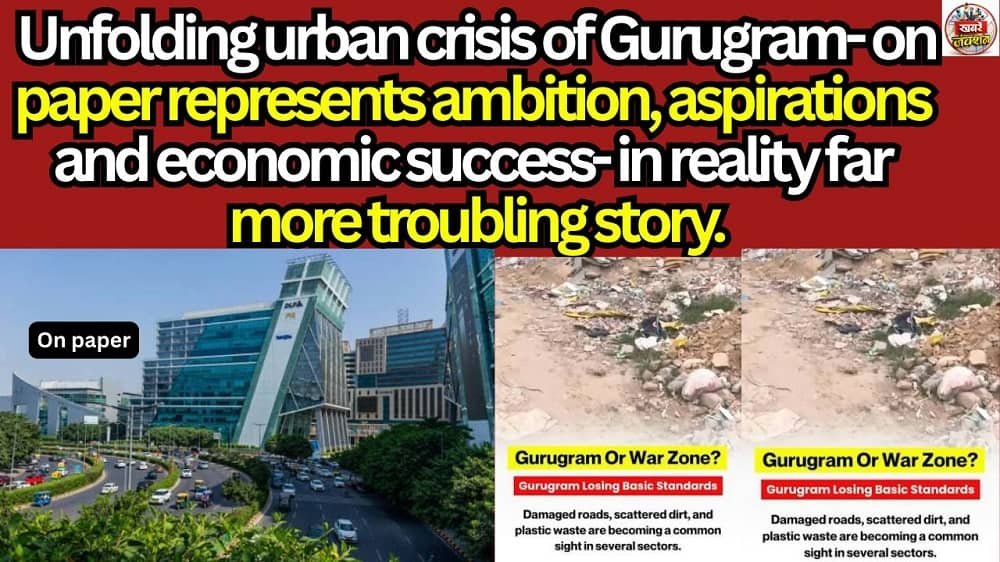
Unfolding urban crisis of Gurugram- on paper represents ambition,aspirations and economic success- in reality far more troubling story.
Gustakhi Maaf, Haryana- Pawan Kumar Bansal
With inputs from our enlightened reader Naveen Rangera.
The Unfolding Urban Crisis of Gurgaon
In the heart of Haryana stands a city once envisioned as a symbol of India’s global ascent—Gurgaon. Often celebrated as the commercial capital of the state, it hosts hundreds of multinational corporations, gleaming corporate towers, and some of the most expensive residential developments in the country, where individual apartments can command prices of up to ₹190 crores.
On paper, Gurgaon represents aspiration, ambition, and economic success. In reality, however, it tells a far more troubling story—one of chronic neglect, systemic apathy, and dangerously unplanned growth.
The Illusion of Prosperity
At first glance, Gurgaon appears to be a city of the future. Glass façades, luxury condominiums, and sprawling business parks dominate its skyline. Yet beneath this veneer lies a fragile and overstretched urban ecosystem. The pace of construction and population growth has far outstripped the development of essential infrastructure. What should have been a model of planned urbanization has instead evolved into a cautionary tale of imbalance.
Infrastructure in Collapse
The most glaring failure is the lack of parallel infrastructure development. As residential and commercial spaces multiply rapidly, foundational systems—water supply, road networks, and electricity—remain inadequate and poorly planned.
Water scarcity has led to the unchecked proliferation of private water tankers, many extracting groundwater unsustainably. Roads, plagued by poor design and haphazard planning, have become choke points due to faulty intersections, poorly timed traffic signals, and incomplete flyovers. Daily commutes often stretch into hours, eroding productivity and quality of life.
Electricity supply remains inconsistent, forcing residents and businesses alike to rely heavily on diesel generators. This not only increases the cost of living but also contributes significantly to environmental degradation.
Environmental Degradation and Pollution
Gurgaon is now frequently listed among the most polluted cities in India. The causes are neither hidden nor complex. Continuous construction activity generates massive dust pollution, while construction and demolition (C&D) waste is routinely left unattended along roadsides.
Vehicular congestion further worsens air quality, with long traffic jams becoming a daily norm. The widespread use of diesel generators and water tankers adds to the toxic mix. The result is an urban environment that is not only uncomfortable but increasingly hazardous to human health.
The Unregulated Underbelly: Villages Within the City
A particularly neglected dimension of Gurgaon’s crisis lies within its urban villages, both in Gurgaon and Manesar. Though these areas fall under municipal jurisdiction, they remain largely unregulated.
Illegal construction flourishes unchecked, with little enforcement of building norms or planning approvals. Residential units are frequently converted into commercial establishments without authorization. Migrant labourers—who form the backbone of Gurgaon’s construction boom—are often forced to live in overcrowded and unhygienic conditions, with minimal access to basic services.
The presence of dairies within residential zones, along with stray cattle roaming freely on roads, creates both safety hazards and sanitation concerns. Meanwhile, the stray dog population continues to rise due to inadequate sterilization efforts, making dog bites an alarmingly common occurrence.
Waste Mismanagement and Urban Flooding
Despite significant expenditure on waste management, garbage disposal remains inefficient and inconsistent. Overflowing dumps, irregular collection, and the lack of scientific processing reflect systemic inefficiencies.
During the monsoon season, Gurgaon’s vulnerabilities are laid bare. Even moderate rainfall leads to widespread waterlogging, paralysing traffic and daily life for hours. The absence of an effective drainage system underscores years of neglect and failed planning. Government assurances and repeated promises have so far yielded little tangible improvement.
Vertical Growth, Horizontal Neglect
Perhaps the most concerning aspect of Gurgaon’s development is the continued approval of high-rise construction despite already strained infrastructure. Vertical expansion is being aggressively pursued without strengthening the horizontal support systems necessary to sustain it.
Each new tower adds pressure on water resources, electricity supply, road capacity, and waste management systems—further deepening the crisis. This unchecked growth is not merely unsustainable; it is actively pushing the city toward systemic failure.
A Call for Urgent Intervention
Gurgaon’s story is not just one of administrative oversight—it reflects prolonged institutional apathy. A city that contributes significantly to the state’s economy and national growth cannot be allowed to deteriorate under the weight of its own success.
What Gurgaon urgently needs is a comprehensive, enforceable urban policy framework that prioritizes infrastructure alongside growth. This includes:
- Immediate upgrading of water, electricity, and road infrastructure
- Strict regulation and monitoring of construction activities
- Enforcement of building norms in urban villages
- Scientific waste management systems
- Effective flood control and drainage planning
- Robust animal control and public health measures
Conclusion
Gurgaon stands today at a critical crossroads. It can either continue on its current path—where growth is chaotic, infrastructure is reactive, and governance is fragmented—or it can be reimagined as a truly modern, sustainable city.
The choice lies with the authorities of Haryana. The time for incremental fixes has long passed. What is needed now is decisive, accountable, and visionary governance—before the “Millennium City” becomes a monument to missed opportunities and administrative indifference.
Tailpiece
It appears that, following a recent cabinet meeting, agencies such as GMDA, MCG, HSVP, and the police have finally stirred from their deep slumber. Of late, some cosmetic action has been taken against illegal construction and late-night noise pollution at pubs—but whether this signals real change or merely tokenism remains to be seen.