
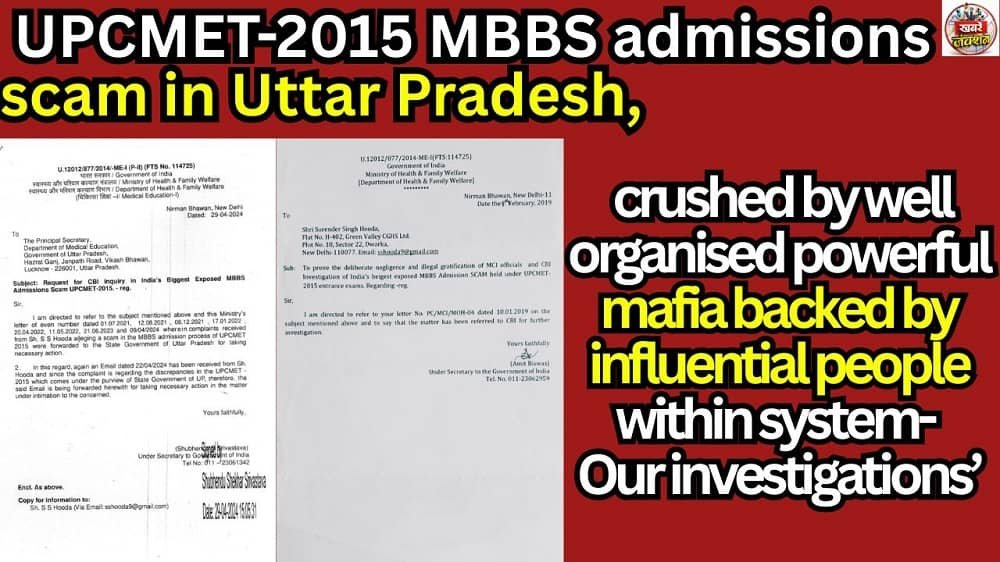
UPCMET-2015 MBBS admissions scam in Uttar Pradesh, crushed by well organised powerful mafia backed by influential people within system- Our investigations’
Gustakhi Maaf Haryana- Pawan Kumar Bansal
MBBS ADMISSION SCAM IN UP THAT NEVER GOT INVESTIGATED
Inside the UPCMET-2015 Cover-Up.
This investigative report examines the alleged irregularities in the UPCMET-2015 MBBS admissions conducted in Uttar Pradesh, highlighting documented discrepancies, administrative inaction, and the sustained efforts of whistleblower Mr. Surender Singh Hooda. Despite official acknowledgment of irregularities, no formal investigation has been completed to date.
1. Introduction
In India’s highly competitive medical education system, transparency and merit are foundational principles. However, documents and official correspondence related to UPCMET-2015 suggest serious deviations from these principles.
This report presents a detailed investigation into the alleged irregularities, supported by official records, representations, and institutional responses spanning nearly a decade.
2. Origin of the Case (2015)
The matter first came to light in October 2015, when Mr. Surender Singh Hooda, a social activist, submitted a formal complaint to the Ministry of Health and Family Welfare (MoHFW), Government of India.
* On 05 October 2015, a written complaint was filed
* On 21 October 2015, audio and video evidence was submitted in person
A committee comprising senior officials of MoHFW and the Medical Council of India (MCI) was constituted. However, instead of initiating a central investigation, the matter was referred to the Government of Uttar Pradesh.
3. Core Allegations
The complaint highlighted the following key issues:
* Discrepancies between entrance merit list and actual admissions
* Admission of candidates inconsistent with merit ranking
* Non-publication of complete merit list
* Alleged capitation fee practices
* Irregularities across multiple private medical colleges
4. Official Acknowledgment (2019)
A critical development occurred on 04 January 2019, when the Board of Governors (BoG) in supersession of MCI examined the case.
Key Observation:
Discrepancies were found between:
* The UPCMET merit list
* Admission records of private medical colleges
The BoG recommended that the matter required investigation by an appropriate agency beyond its jurisdiction.
5. Referral to CBI and Subsequent Developments
Following the recommendation:
* February 2019: MoHFW referred the matter to the Central Bureau of Investigation (CBI)
* February 2020: CBI transferred the matter to Uttar Pradesh Vigilance citing jurisdictional limitations
Status:
* No FIR registered
* No investigation initiated
* No conclusive findings reported
6. Administrative Response and Record Concerns
Subsequent communications revealed a concerning development:
The Directorate of Medical Education, Uttar Pradesh indicated that:
“No record is available” regarding UPCMET-2015 admissions in private medical colleges.
This raises serious concerns regarding:
* Record maintenance
* Regulatory oversight
* Administrative accountability
7. Continued Representations (2015–2026)
Mr. Surender Singh Hooda has continuously pursued the matter through:
* Representations to MoHFW, MCI, CBI
* Communications with Prime Minister’s Office
* Appeals to the President of India
* Follow-ups with State and Central authorities
Despite sustained efforts, the case remains uninvestigated.
8. Legal Escalation (2022–2024)
In subsequent representations to CBI:
* A formal request for FIR registration was made
* Allegations included corruption and illegal gratification
* Reference was made to a Supreme Court Constitution Bench judgment (2022) emphasizing that circumstantial evidence can sustain prosecution in corruption cases
No FIR has been registered till date.
9. Pattern of Institutional Inaction
The case reflects a recurring administrative pattern:
* Referral between agencies without conclusion
* Lack of ownership by investigative bodies
* Absence of time-bound action
This has resulted in prolonged delay despite documented evidence and recommendations.
10. Role of the Whistleblower
The role of Mr. Surender Singh Hooda is central to this case.
Over nearly a decade, he has:
* Gathered and submitted evidence
* Appeared before official committees
* Maintained a consistent documentary trail
* Persistently followed up with authorities
His efforts have ensured that the issue remains on record despite systemic inaction.
11. Broader Implications
The UPCMET-2015 case raises important questions:
* Integrity of medical admission systems
* Regulation of private medical colleges
* Accountability of public institutions
* Effectiveness of investigative mechanisms
It also highlights the challenges faced by whistleblowers in pursuing public interest issues.
12. Conclusion
The available records establish that:
* Irregularities in admissions were officially acknowledged
* The matter was referred for investigation
* No investigative agency has completed inquiry
* No FIR has been registered
Nearly a decade later, the case remains unresolved.
The issue underscores the need for a transparent and independent investigation to uphold the integrity of medical education and restore public trust in institutional processes.
Author Note
This investigative report is based on documented representations, official communications, and records available in the public domain and with the complainant.