
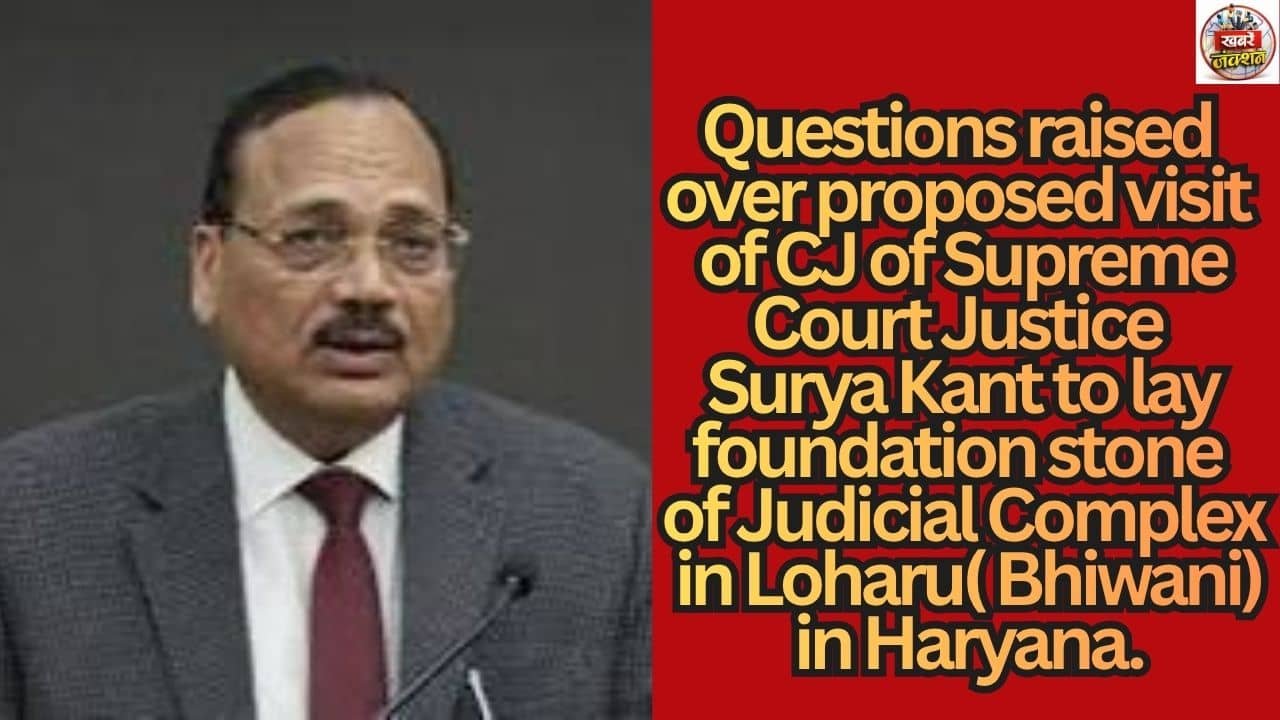
Questions raised over proposed visit of CJ of Supreme Court Justice Surya Kant to lay foundation stone of Judicial Complex in Loharu( Bhiwani) in Haryana.
Gustakhi Maaf Haryana- Pawan Kumar Bansal
Questions have been raised over the proposed visit of Justice Surya Kant to lay the foundation stone of the Loharu Judicial Complex in Bhiwani district, Haryana.
While there is nothing illegal or unethical in the Chief Justice of India presiding over such an event, some observers argue that the responsibility could have been delegated to the Administrative Judge of the district or the Chief Justice of the Punjab and Haryana High Court.
Concerns have also been expressed regarding the administrative impact of the visit. Officials note that preparations for a Chief Justice’s visit typically affect court and administrations functioning in the host district for several days. Additionally, on the day of the function the presence of the High Court Chief Justice and other judges is expected, which could disrupt proceedings in courts already burdened with long-pending cases.
It is acknowledged that Justice Surya Kant has roots in Haryana, and his association with the region is seen as a positive gesture. However, some suggest that the foundation stone ceremony could alternatively be conducted via video conferencing, possibly on a court holiday, to minimize disruption.
Meanwhile, preparations for the event are underway.
Justice Kuldeep Tiwari, Administrative Judge for Bhiwani district, visited Bhiwani on wednesday to review the arrangements. He confirmed that the Chief Justice of India will visit Bhiwani on April 25 to lay the foundation stone of the judicial complex in Loharu.
Justice Tiwari issued necessary directions to officials regarding the function,Senior judicial and administrative officers, including District and Sessions Judge D.R. Chalia (Bhiwani), District and Sessions Judge Gagandeep Kaur Singh (Dadri), and Deputy Commissioner Bhiwani Sahil Gupta, attended the meeting.
Earlier, Justice Tiwari was received at the Public Works Department rest house, where he was accorded a guard of honour. He later chaired a detailed review meeting with judicial and administrative authorities to assess preparedness for the upcoming visit.