
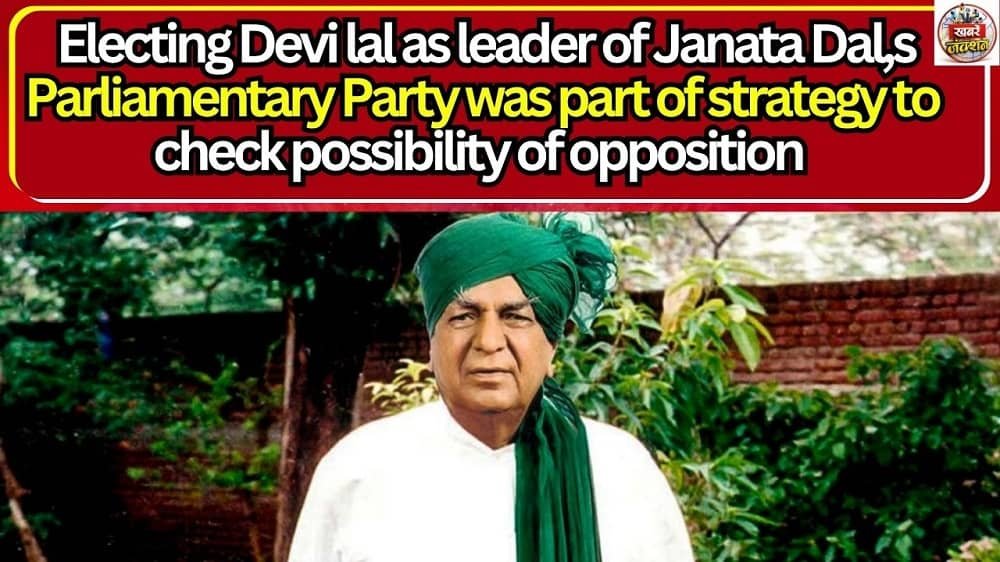
Electing Devi lal as leader of Janata Dal,s Parliamentary Party was part of strategy to check possibility of opposition by Chandra Shekhar in case name of VP Singh was proposed.
Gustakhi Maaf Haryana — Pawan Kumar Bansal
In the corridors of power, many decisions appear to unfold in the open, yet their real scripts are often crafted behind closed doors. One such intriguing episode dates back to the era of Devi Lal, V.P. Singh, and Chandra Shekhar.
It is widely known that Devi Lal, who was unanimously elected leader of the Janata Dal Parliamentary Party, voluntarily stepped aside and proposed V.P. Singh’s name for the post. On the face of it, the move seemed straightforward—had he not done so, Devi Lal himself would likely have become the Prime Minister. However, the real story begins here.
At the time, there was a palpable concern that if V.P. Singh’s name had been proposed directly, Chandra Shekhar might have entered the fray. Such a contest could have signaled internal divisions within the party and sent the wrong message to the public—especially since the election had largely been fought under V.P. Singh’s leadership.
A strategy was therefore devised. After deliberations at the highest level, it was decided that Devi Lal’s name would be proposed first—a candidate difficult for anyone to openly oppose. The plan was clear: elect Devi Lal unanimously, and then have him propose V.P. Singh’s name.
That is precisely how events unfolded.
It was a carefully calculated political move, akin to a game of chess, where every piece had a defined role. At the time, Devi Lal was regarded as a staunch admirer of V.P. Singh. His famous slogan echoed across the political landscape: “Not a king, but a fakir—he is the nation’s destiny.”
But in politics, alliances are rarely permanent. After the government was formed, differences began to surface between the two leaders. The same Devi Lal, who once sang V.P. Singh’s praises, later emerged as one of his sharpest critics. His slogan, too, took a dramatic turn: “Not a king, but a pauper—he is a blot on the nation.”
Such is the reality of Indian politics—where friendships and rivalries alike are shaped, and reshaped, by time and circumstance.