
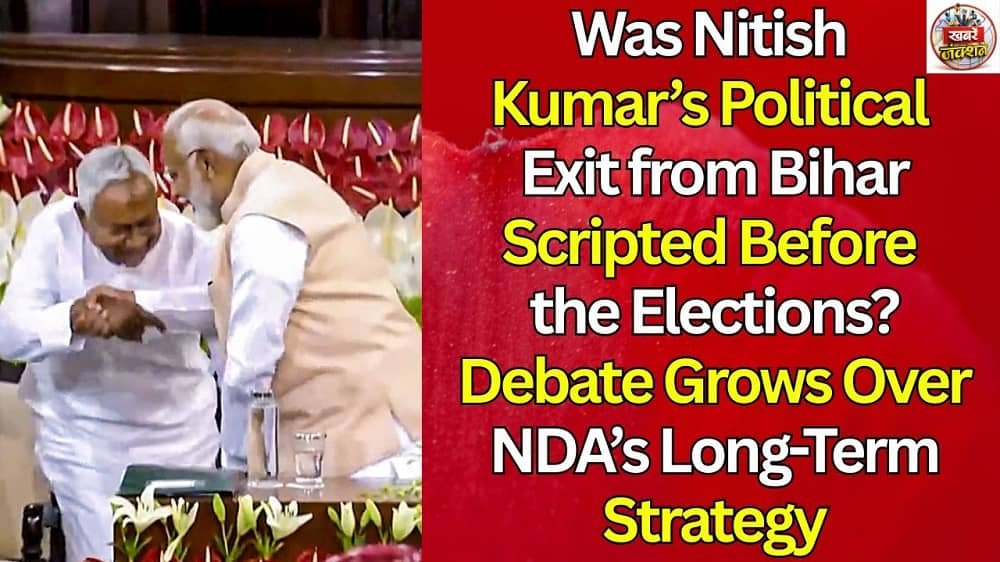
Was Nitish Kumar’s Political Exit from Bihar Scripted Before the Elections? Debate Grows Over NDA’s Long-Term Strategy
Gustakhi Maaf Haryana – Pawan Kumar Bansal
By our enlightened reader Satish Mehra
Was Nitish Kumar’s Exit from Bihar Scripted Even Before the Elections?
Satish Mehra
On October 17, 2025, the author wrote an article titled “BJP Balanced the Equation in NDA Ticket Distribution.” In that article, a section referred to as the “Nitish Exit Script” suggested that major political changes could unfold in Bihar in the near future and that Chief Minister Nitish Kumar’s active political role might gradually become limited. At that time, the observation was considered merely a political assessment. However, looking at the present circumstances, many political analysts now believe that the concerns expressed in that article appear to be proving largely accurate.
In fact, the seat-sharing arrangement within the National Democratic Alliance (NDA) before the Bihar Assembly elections was viewed by many as more than a routine electoral compromise. It was widely interpreted as part of a long-term political strategy. The argument at the time was that if the balance of seats within the alliance was structured in such a way that the indispensability of any single party was reduced, the real control of power could gradually shift to another party. This is why discussions had already begun during ticket distribution that the political balance of power in Bihar might change in the future.
Looking at the present composition of the Bihar Legislative Assembly, it becomes evident how the political arithmetic has evolved. In the 243-member assembly, the distribution of seats shows that the Bharatiya Janata Party has emerged as the largest political force. The party currently holds 89 MLAs, while Janata Dal (United) has 85 MLAs. In addition, Rashtriya Janata Dal has 25 MLAs, Lok Janshakti Party (Ram Vilas) has 19 MLAs, Indian National Congress has 6 MLAs, All India Majlis-e-Ittehadul Muslimeen has 5 MLAs, Hindustani Awam Morcha (Secular) has 5 MLAs, Rashtriya Lok Morcha has 4 MLAs, Communist Party of India (Marxist–Leninist) Liberation has 2 MLAs, Communist Party of India (Marxist) has 1 MLA, Bahujan Samaj Party has 1 MLA, and one seat belongs to an independent member.
When these numbers are viewed in a broader political context, the position of the NDA alliance appears extremely strong. The combined strength of the BJP, JD(U), LJP (Ram Vilas), HAM (Secular) and Rashtriya Lok Morcha is estimated to be around 202 seats, indicating a very comfortable majority in the 243-member assembly. For this reason, many political observers believe that the center of power in Bihar politics is gradually shifting.
Political analysts argue that the seat distribution before the elections was not merely an immediate electoral strategy but also a plan shaped by future political calculations. At that time, particular attention was drawn to the question of why the party led by Chirag Paswan, the Lok Janshakti Party (Ram Vilas), was given a relatively larger share of seats. Initially, this was interpreted as an attempt to strengthen the alliance. However, subsequent developments have triggered a fresh debate about the possible long-term strategy behind that decision.
If the current political arithmetic is examined, the BJP has 89 MLAs while Chirag Paswan’s party has 19 MLAs. In addition, the Hindustani Awam Morcha (Secular) led by Jitan Ram Manjhi has 5 MLAs, and the Rashtriya Lok Morcha led by Upendra Kushwaha has 4 MLAs, all of whom are considered aligned with the same political axis. Together, this number reaches approximately 117. Since the majority mark in the assembly is 122 seats, analysts believe that even if a situation arises where the support of JD(U) weakens, the majority could still potentially be achieved through political adjustments.
In this context, it is also being argued that the changing balance of power has increased political pressure on Nitish Kumar. There was a time when he was viewed as a potential prime ministerial face within the Indian National Developmental Inclusive Alliance (INDIA) bloc. At the same time, for many years, a strong perception existed in Bihar politics that Nitish Kumar was the leader who created the most effective political balance with Narendra Modi. However, changing political equations are now beginning to challenge that perception.
As a result, a key question is now emerging in Bihar politics: is Nitish Kumar’s era of active leadership nearing its end? His move to the Rajya Sabha is now considered almost certain. This development is not being viewed merely as a personal political decision but as a sign of a broader restructuring of power in Bihar. Many analysts point out that the Rajya Sabha route is often chosen when a leader’s role shifts away from active state politics to a more limited national role.
This entire development has sparked a new debate in Bihar’s political landscape. Is this the beginning of the end of the long tradition of socialist politics in the state, or is it simply a phase of p
olitical transition? Nitish Kumar has long been regarded as one of the prominent faces of socialist politics in Bihar. If he withdraws from active state leadership, it is natural to ask whether that political legacy will continue.
Another discussion that occasionally surfaces is whether Nitish Kumar might encourage his son Nishant Kumar to enter active politics. In some political circles, speculation has even arisen about the possibility of him being promoted for a role such as Deputy Chief Minister in the future. At present, however, these remain political conjectures.
At the same time, another question continues to be raised. During the Bihar elections, slogans such as “25 to 30, Phir Se Nitish” were frequently heard. If the same leader is now prepared to move to the Rajya Sabha, the natural question arises: is this his voluntary decision, or the result of political circumstances? Some analysts argue that a chief minister who once harbored ambitions of becoming prime minister would not easily agree to such a shift. Therefore, it is also being suggested that political pressure from the BJP could be one of the factors behind this development.
On the other hand, some observers argue that Nitish Kumar may have decided to step back from active administrative responsibilities due to health and age considerations. If that is the case, it may simply represent a natural political transition. Yet in politics, every decision has multiple layers, and drawing a final conclusion at this stage may be premature.
What is clear, however, is that Bihar politics is entering a new phase. In the coming years, it will become evident whether the chapter of socialist politics is truly ending or whether new faces such as Nishant Kumar will attempt to carry it forward. Nevertheless, the present political scenario strongly suggests that the groundwork for these changes had been laid well in advance. In that sense, it may not be an exaggeration to say that the script for Nitish Kumar’s political exit from Bihar may indeed have been written even before the elections.
khabre junction