
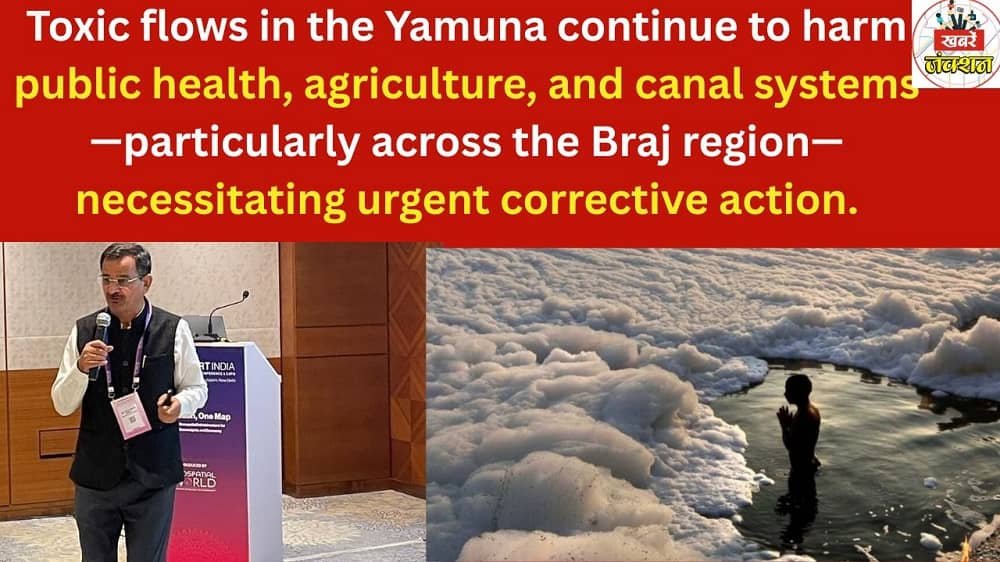
Toxic flows in the Yamuna continue to harm public health, agriculture, and canal systems—particularly across the Braj region—necessitating urgent corrective action.
Gustakhi Maaf Haryana- Pawan Kumar Bansal
Reviving the Yamuna: Dr. Rawat Unveils Community-Powered, Tech-Driven Solutions at GeoSmart India 2025 Water Summit
Dr. Shiv Singh Rawat, Convener of the Yamuna Bachao Abhiyan and Former Superintending Engineer, Irrigation & Water Resources Department, Haryana, shared powerful insights from the Walk for Yamuna (WFY) campaign and outlined a strategic roadmap for river rejuvenation at the Water Management Summit during the Silver Jubilee edition of GeoSmart India 2025, held at Bharat Mandapam, New Delhi.
Dr. Rawat highlighted that the WFY campaign—and similar citizen-led efforts—successfully pushed the issue of Yamuna pollution to the centre of public and political discourse in 2024, with the “Yamuna factor” influencing governance priorities and even electoral narratives. The campaign reaffirmed that when communities lead, policymakers listen.
He stressed that convergence of national initiatives such as JSA, ABY, JJM, JSJB, Amrut Sarovar, and Catch the Rain can deliver significant impact, provided active citizen participation is embedded. However, he underscored serious governance gaps, including weak inter-departmental coordination, limited accountability, and inadequate public engagement.
Warning of the worsening situation, Dr. Rawat noted that toxic flows in the Yamuna continue to harm public health, agriculture, and canal systems—particularly across the Braj region—necessitating urgent corrective action.
Insights at GeoSmart India 2025
Speaking on “Stakeholder Engagement & Institutional Coordination,” Dr. Rawat identified community stewardship, ecological restoration, integrated governance, and geospatial technologies as the four pillars of future-ready water management. He called for transparent data systems, joint action plans, empowered local bodies, and youth-led community mobilisation to drive sustained change.
The Way Forward
Dr. Rawat urged continuous capacity building, stronger civic participation in river management, development of biodiversity parks, clean return flows, and greater adoption of nature-based and technology-driven solutions. He appealed to the new governments in Delhi and Haryana to honour their commitments to revive the dying Yamuna.
Reaffirming the river’s ecological, cultural, and spiritual importance, he concluded: “If rivers survive, we survive.”