
Betraying the Voter’s Trust
Gustakhi Maaf Haryana- Pawan Kumar Bansal
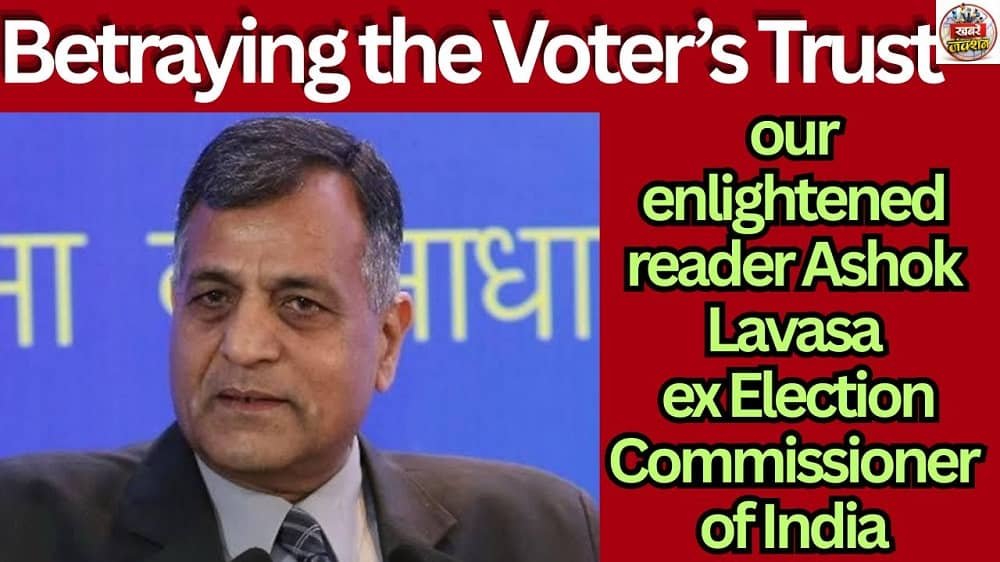
By our enlightened reader Ashok Lavasa ex Election Commissioner of India.THE “transmogrification” of seven Rajya Sabha MPs (Members of Parliament) of the Aam Aadmi Party has reignited the defection debate. While this phenomenon might not be unique to India, it seems a form of “soul-searching” by people increasingly accused of not possessing one. It represents the art of being here today and there tomorrow with the craft of doing it with guile and without guilt.
Changing one’s political beliefs and affiliation should normally be treated as a process of “growing up” politically due to a change of heart or ideological awakening. Elected representatives are ‘jolted’ by their conscience, smitten by a realisation of their leader’s “betrayal”, and a desire for betrothal with another party they decried. Elegy and eulogy merge into something hard to define and difficult to understand.
The Constitution guarantees liberty of thought and expression and the right to form associations. Then, why label this “defection” a negative political behaviour necessitating a law to regulate such conduct? The Constitution didn’t deal with defection originally in its innocent belief in the strength of character of the political class.
I won’t venture into the history of defections in India, although I served the state credited with the origin of the species of Aaya Ram, Gaya Ram. Haryana gave a live demonstration of the Bhagavad Gita sermon of the soul never dying but changing form, when the chief minister led his cabinet to mutate by joining another party in 1980.
What bears elaboration, however, is while defection is undesirable, to act as per free will is fundamental to the concept of freedom. Many see the Tenth Schedule of the Constitution, introduced by the 52nd Amendment Act (1985), and its subsequent modification by the 91st Amendment Act (2003) as a deterrent to elected representatives acting of their free will. The anti-defection law was brought about to ensure political stability by disallowing the UK-style ‘free-seating’ in Parliament. However, this merely dissuaded solitary acts of changing political loyalties but allowed wholesale transaction, originally one-third, increased later to two-thirds of the party inside and outside the House.
The utilisation in politics of the effective trade practice of “bulk-buying” reflects both a time-tested market formula and a morally resilient political culture. In politics, bulk discount converts into a premium because those who put themselves on offer must ensure being bundled with kindred souls in order to make up the two-thirds. The unique feature of this product is that only two-thirds of the whole is sold; one-third is retained for a possible resale, should circumstances so warrant. The circumstances could be created by the “inner voice” that scriptures exhort us to hear or the scripted “external threat” that the mind is trained to perceive.
Legal luminaries will now delve into the nuances of law and the litany of relevant judgments that the Rajya Sabha Chairman should have kept in view before speedily sanctifying the transmogrified (mortified?) MPs. Honourable courts, persuaded by learned lawyers, might uphold the decision. The days when people in authority disagreed with each other seem passé and morality seems an effete concern.
This is no comment on the courts; this is how laws have been written, enabling the elected representative to act in accordance with the letter while abandoning its spirit. It is an act of hubris where elected representatives presume that their switchover has the endorsement of their voters.
What indeed is the spirit of being elected? Is it in any way affected by such change of loyalties? Most candidates winning elections belong to political parties. Independent candidates may make promises; they don’t write manifestos. Parties do; and candidates winning on their ticket are bound by their manifestos as they contest on a common symbol. Where does it leave defecting candidates who, after elections, discard the support of those who voted for them? They were not the choice of those who didn’t vote for them and are technically left without any support in their constituencies but continue to be their elected representatives. What kind of “representation” is this?
It could be argued that an individual’s personal influence, no matter which party, earns him/her popular support. That makes the individual larger than the party, undermining the raison d’être of political parties. After all, parties represent a certain political thinking or ideology; at least they are meant to. While an individual may suffer “pangs of conscience”, parties are not known to suffer this malady, although there have been instances of “mergers and acquisitions”. While parties “merge”, elected representatives are “acquired” in the Indian political marketplace.
In such an environment, why should we be obsessed with multiplying the number of representatives because of a fictional notion of being underrepresented? Has anyone evaluated whether smaller constituencies are better served by elected representatives than the larger ones? Yet there is a furious debate on delimitation to serve the abstract principle of “One Vote, One Value”. A Parliamentary Committee also deliberates on the avoidable alternative of “One Nation, One Election”, aimed at minimising the interface between the elector and the elected.
What is the sanctity of my vote if the person I elect has the freedom to discard it and embrace the one that I rejected? It is time the anti-defection law is revisited. Let the law not prohibit elected representatives from switching sides, but the MP/MLA must go back to the electors for a fresh mandate, giving voters the opportunity of soul-searching.
The splitting of a political party is a different matter and must be governed by the applicable law for the formation of political parties. Even if the party splits and the breakaway entity qualifies to be recognised as a separate party, the elected representatives must lose their seats. This would entail a ‘wasteful’ exercise of repeated elections, a cost a healthy democracy must learn to afford. Otherwise, we risk becoming a nation where riches and cunning matter more in politics than being consistent and scrupulous, and value is preferred over values.
…