
Haryana Excels in UPSC, Yet HPSC Vacancies Raise Questions
Gustakhi Maaf Haryana – Pawan Kumar Bansal
By our enlightened reader Satish Mehra
Haryana’s Success in UPSC, But Vacancies in HPSC — Where Is the Problem?
The youth of Haryana today are proving their talent across the country and the world. From defending the nation’s borders to excelling in international sports arenas and administrative services, the young people of Haryana have created a distinct identity for themselves. In terms of geography and population, this state is not very large. Haryana accounts for only about one and a half to two percent of India’s total geographical area, yet in terms of achievements this small state appears ahead of many larger states. The success of the state’s youth in various fields has given Haryana a distinctive recognition at the national and international levels.
Haryana’s contribution in the field of sports is the biggest example of this. In international competitions such as the Olympics, Asian Games, and Commonwealth Games, nearly 25 percent of the total medals won by India come from athletes belonging to Haryana. Considering the state’s small population and limited geographical area, this contribution is regarded as extraordinary. This is why Haryana is often referred to as the country’s “medal factory” in the world of sports.
Haryana’s contribution to national defense is also significant. Nearly 10 percent of the officers and soldiers serving in the Indian Army come from Haryana. Whether it is safeguarding the nation’s borders or hoisting the tricolor on the sports field, the youth of Haryana appear to be playing a leading role in every sphere. Not only this, the participation of Haryana’s youth in prestigious examinations such as the civil services has also been steadily increasing.
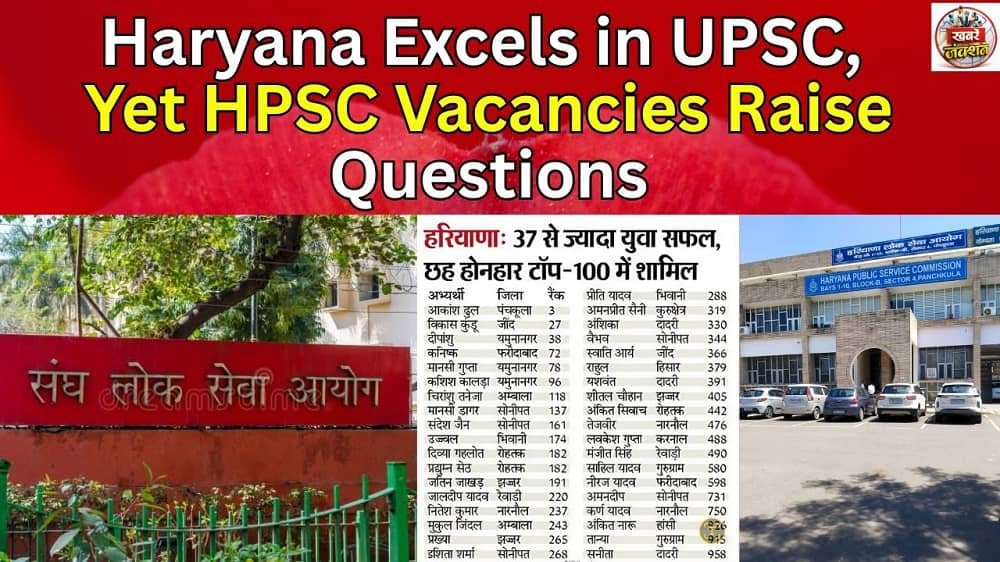
In this context, the Civil Services Examination conducted by the Union Public Service Commission is considered one of the toughest and most prestigious examinations in the country. In the recently declared results as well, the youth of Haryana achieved remarkable success. This year, around 37 young men and women from the state cleared the UPSC examination. Last year, more than four dozen candidates from Haryana had succeeded in this examination. At that time, the state government had honored these successful candidates, and the Chief Minister had invited them to his residence to congratulate them. Even this year, around half a dozen candidates secured places in the top 100, bringing pride to the state.
However, alongside this success, an interesting yet serious contradiction also becomes visible. When Haryana’s youth hoist the flag of success in UPSC, the state government and the Chief Minister do not hesitate to applaud them. Their achievements are described as the achievements of the entire state, and they are projected as a source of inspiration. But when it comes to the state’s own recruitment agency, the Haryana Public Service Commission, the picture looks quite different. A large number of posts remain vacant, and many qualified candidates are left out of selection. This naturally raises the question: what is the reason behind this contradiction?
This year, a total of 1087 vacancies were announced in the UPSC examination, but in the final result only 958 candidates were recommended. In other words, around 129 posts remained vacant. If the reservation ratio is considered, more posts belonging to the Scheduled Caste category should ideally have been filled, but the actual selection was comparatively lower. This raises the question of why the reserved posts are not being fully utilized.
This issue does not appear to be limited to UPSC alone. A similar situation can also be seen in the selection agencies of various states. In Haryana, the recruitment of Assistant Professors has emerged as a clear example. A large number of posts were reserved for various categories in the English subject, yet the results were extremely limited. For instance, 60 posts each were reserved for certain categories, but only three candidates were declared successful, and even they were adjusted in the general category. In the BC-A category, only 5 candidates were declared successful against 85 posts. In the BC-B category, merely 3 candidates succeeded against 36 posts, while in the Economically Weaker Section only 6 candidates were found eligible against 60 reserved posts.
The overall figures of the Assistant Professor recruitment are even more surprising. For a total of 1010 posts, according to the rules nearly 2020 candidates should have been declared qualified for the next stage. However, in reality only 502 candidates were declared successful. Subject-wise data further highlights the seriousness of the situation. In English, only 151 candidates were selected against 613 posts; in Economics, 24 candidates were selected out of 43 posts; and in Defence Studies, only 7 candidates were selected against 23 posts.
Similarly, the situation in the recruitment of PGT teachers and Ayurvedic Medical Offi
cers has also not been satisfactory. Out of 3382 total posts in these recruitments, only 2129 candidates could be selected, meaning nearly one-third of the posts remained vacant. In a core subject like Mathematics, 345 posts were filled out of 414, whereas in Physics only 100 candidates were selected against 410 posts. In backward regions such as Mewat, the situation was even more alarming—only 1 candidate was selected out of 42 Mathematics posts, and only 2 candidates were selected out of 59 Physics posts.
The most significant impact has been on the reserved categories. In the PGT and AMO recruitment, while 1458 posts were filled out of 1852 unreserved posts, only 125 candidates were selected out of 345 posts in BC-A, 69 out of 177 in BC-B, 324 out of 674 in the Scheduled Caste category, and 164 out of 334 in the EWS category. In the PGT Computer Science selection process, the situation was even more shocking. Against nearly 1700 posts, only 39 candidates were declared qualified, which raises serious questions about the recruitment process.
When candidates possessing PhD degrees, UGC-NET qualifications, and years of teaching experience are being declared unsuccessful in large numbers, it naturally raises the question whether the examination is truly assessing merit or whether the policy itself has become impractical. In the name of maintaining quality, if classrooms remain empty and students are left without teachers, then reconsidering such a selection process becomes the need of the hour.
The Haryana government must now decide whether the state will remain limited to producing capable officers for national-level examinations, or whether it will also strengthen its identity in the fields of education and intellectual leadership. The Haryana that gives the country soldiers, farmers, and champions in sports cannot afford to lag behind in providing teachers. If that happens, it would not only be an administrative failure but also an injustice to future generations.