
Teacher Selection in Haryana: A Test of Merit or a Policy Failure? HPSC Recruitment Under Scrutiny
Gustakhi Maaf Haryana-Pawan Kumar Bansal
By our enlightened reader Satish Mehra .A Test of Merit or a Policy Failure? Teacher Selection in Haryana Under Scrutiny?
Haryana, a state that has historically given the nation an impressive number of capable officers through competitive examinations conducted by the Union Public Service Commission, now finds itself struggling to produce equally competent teachers. This contrast raises an important question: Is the fault with the state’s educational institutions, the academic environment, the teachers themselves, or the recruitment process implemented by the Haryana Public Service Commission (HPSC)? One thing is certain — when Haryana’s students perform exceptionally well in national-level examinations but fail to succeed in HPSC recruitments, it becomes a matter of serious concern.
At the heart of this debate is the new recruitment system introduced by the Haryana Public Service Commission, particularly the requirement of a mandatory minimum of 35 percent marks in the Subject Knowledge Test. This criterion was introduced in the name of ensuring quality, yet its practical outcome has been that thousands of posts have remained vacant while many capable candidates have been eliminated from the selection process. Most notably, this recruitment policy has, in effect, negated the reservation policy, and among those who did qualify, a significant number are candidates from other states, not Haryana.
The situation becomes even more troubling when we examine the Assistant Professor recruitments at the college level. Out of 1,010 advertised positions, nearly 2,020 candidates were expected to be shortlisted for the next stage according to the rules, yet only 502 candidates were ultimately declared successful. In English alone, out of 613 vacancies, only 151 were filled; in Economics, 24 out of 43; and in Defence Studies, just 7 out of 23 candidates succeeded. These stark figures point to a growing crisis in the higher education system.
The impact on reserved category candidates is even more disheartening. For Assistant Professor recruits, only 46 of 130 seats meant for BC-B were filled, 47 out of 298 for BC-A, 23 out of 192 for Scheduled Castes, and 44 out of 196 for EWS categories. Such outcomes not only leave positions unfilled but also disrupt the constitutional balance of social representation.
The data from PGT and Ayurvedic Medical Officer recruitments further exposes the gravity of the situation. Of the total 3,382 posts, only 2,129 candidates were selected, leaving nearly one in every three posts vacant. In core subjects like Mathematics, only 345 out of 414 positions were filled, and in Physics, the situation was worse, with just 100 candidates selected out of 410. In the educationally backward Mewat region, the crisis is glaring — out of 42 Mathematics posts, only 1 was filled, and out of 59 Physics posts, only 2.
Even in languages and humanities, the results are far from encouraging. Out of 69 Sanskrit positions, only 43 were filled; Punjabi saw 39 out of 50; Urdu was filled merely 2 out of 4; and in Political Science, only 192 out of 283 positions were occupied. In Mewat’s Political Science vacancies, again only 2 out of 59 posts were filled. Vacancies in subjects like Physical Education, Fine Arts, and History demonstrate that teacher shortages will directly affect continuity and quality of education in schools.
The most serious impact is on reserved category candidates in PGT and Ayurvedic Medical Officer recruitments. While 1,458 out of 1,852 general category posts were filled, only 125 of 345 BC-A posts, 69 out of 177 BC-B posts, 324 out of 674 Scheduled Caste posts, and 164 out of 334 EWS posts were filled. These figures clearly indicate that the 35 percent requirement is weakening — rather than strengthening — the spirit of affirmative representation.
When candidates with PhDs, cleared UGC-NET, and extensive teaching experience are declared unsuccessful, it becomes natural to ask whether the examination is genuinely testing merit or if the policy itself has become impractical. If classrooms remain empty in the name of quality, denying students the teachers they need, then it is imperative to rethink this selection process. A recent move by the Haryana government to reduce the cut-off for disabled candidates from 45 percent to 35 percent in ACS recruitments shows a step in the right direction.
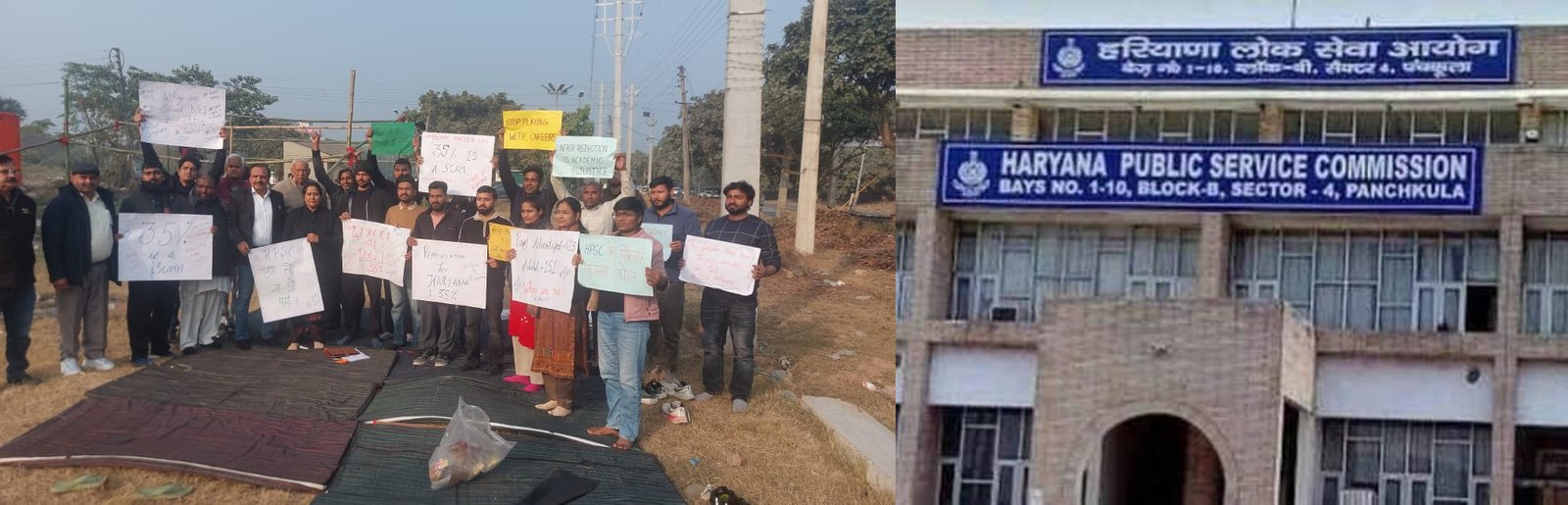
Meanwhile, candidates affected by the HPSC’s “Not Found Suitable” policy have begun an indefinite protest in Panchkula and have approached the Punjab & Haryana High Court. They demand that the 35 percent criterion be removed from Assistant Professor recruitments, that twice the number of candidates (two times the vacancies) be called for interviews, and that all posts — including those reserved for specific categories — be filled. They argue that leaving reserved posts vacant is a blatant violation of constitutional mandates.
Now, the government of Haryana must decide whether the state will remain known only for producing capable officers in national examinations, or whether it will also strengthen its standing in education and intellectual leadership. A land that gives the nation its soldiers, farmers, and athletes cannot afford to fall behind in producing quality educators. If it does, this will not just be an administrative failure, but an injustice to future generations.