
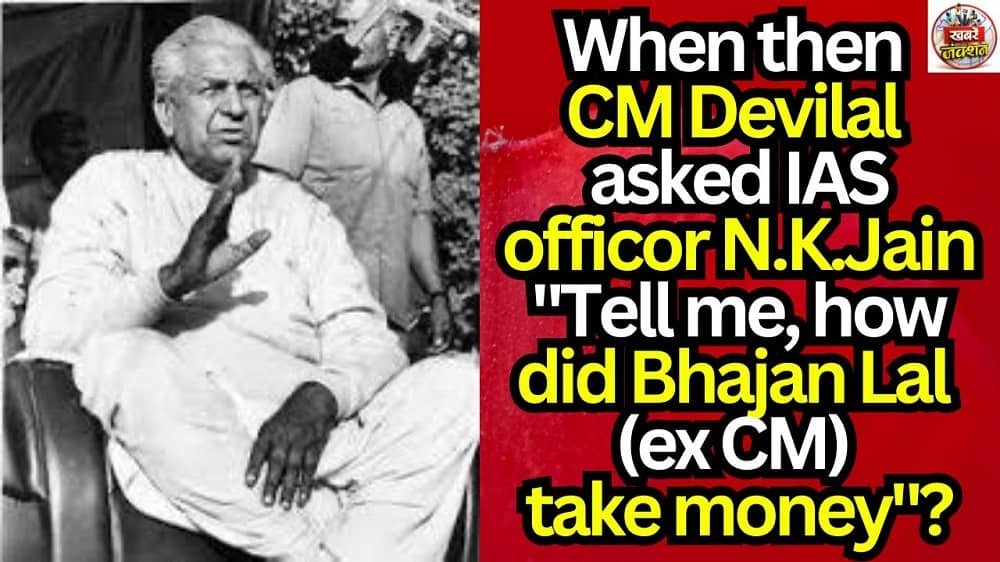
When then CM Devilal asked IAS officor N.K.Jain “Tell me, how did Bhajan Lal (ex CM) take money”?
Gustakhi Maaf Haryana — Pawan Kumar Bansal
Extracts from my upcoming book on politics, culture and governance of Haryana, “Murky Politics of Haryana”. Here is a glimpse of one of its many engaging anecdotes.
When Devi Lal, then CM, asked an IAS officer N.K. Jain: “How did Bhajan Lal take money?”
Chaudhary Devi Lal, fondly known as Tau, was a remarkable and often unpredictable political figure. After spearheading a nationwide movement against Rajiv Gandhi, then Prime Minister, he played a pivotal role in bringing Vishwanath Pratap Singh to power in Delhi. Yet, when disillusioned, he did not hesitate to remark sharply, calling him “not a king, but a pauper—a blot on the nation.”
Like Devi Lal, Haryana’s other prominent “Lals”—Bansi Lal and Bhajan Lal—along with figures such as Hardwari Lal and Pandit Bhagwat Dayal, and of late Manohar Lal, have long been the subject of widely discussed political anecdotes. In contrast, Manohar Lal Khattar is often perceived as more restrained, with fewer lighthearted stories and more stern, controversial ones making the rounds.
The Jeep Purchase Meeting
During a High-Power Purchase Committee meeting, several items—including the procurement of police jeeps—were under consideration. The plan was to purchase vehicles from Mahindra.
At the meeting, Devi Lal turned to N.K. Jain, then head of the Supplies and Disposal Department, and asked bluntly, “Tell me, how did Bhajan Lal take money?”
Jain replied that he had no knowledge of such matters.
Unconvinced, Devi Lal instructed that the owner of the Mahindra dealership be called in, remarking candidly, “Bhajan Lal used to take suitcases full of money. I will take it openly, in front of everyone, for the party fund.”
Jain cautioned him about the potential fallout, even citing the example of Maharashtra Chief Minister A.R. Antulay’s trust controversy as a warning. Devi Lal retorted, “Are you trying to scare me?”
The matter eventually subsided after his secretary, Malik Sahib, intervened.
Devi Lal was also known for his generosity. On one occasion, a Chandigarh-based journalist who had come to invite him to his son’s wedding was handed a bag full of cash, with Devi Lal instructing him to celebrate the wedding in grand style. The journalist was reportedly astonished upon seeing the amount inside.
In another instance, he is said to have asked IAS officer Anil Razdan how Bansi Lal “handled money,” and once jokingly told Razdan’s wife, Rajni Razdan, “Are you the Chief Minister, or am I?”
These are just a few of the many vivid and often humorous anecdotes you will find in the book. The book promises not only to entertain but also to offer a unique window into Haryana’s political culture—stories so lively they might just leave you laughing out loud, perhaps even more effective than today’s expensive medicines.