
“Of saffron Turbans,BJP and the Sikhs“
Gustakhi Maaf Haryana – Pawan Kumar Bansal
By Jagtar Singh, my senior colleague of Indian Express
“Of Saffron Turbans, BJP and the Sikhs.”
The Maharashtra government earlier released advertisements in newspapers regarding a function to commemorate the 350th martyrdom anniversary of the ninth Sikh Guru, Guru Tegh Bahadur, in Navi Mumbai. Guru Tegh Bahadur was martyred in Delhi on the orders of Mughal Emperor Aurangzeb. The Guru opted for this supreme sacrifice for human rights and religious freedom. There should be nothing unusual about a state government inserting such an ad in newspapers. However, it was unusual at one level.
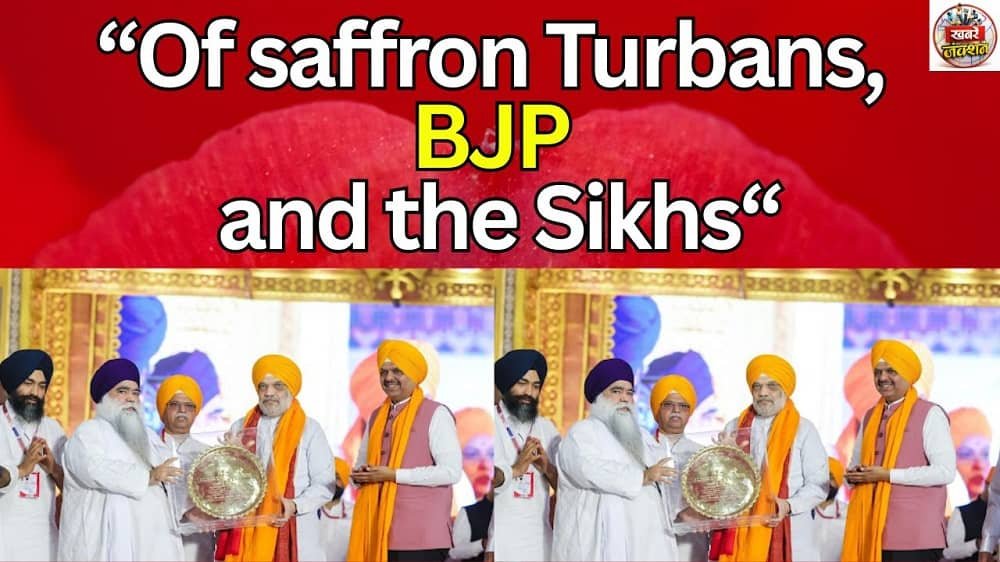
The leaders whose pictures the ad carried included Prime Minister Narendra Modi, Union Home Minister Amit Shah, Maharashtra Chief Minister Devendra Fadnavis, his Deputy Chief Minister Eknath Shinde and others. What was striking about this ad was that all these leaders donned turbans with saffron being the dominant colour. The Ninth Sikh Guru sacrificed his life for the cause of humanity and human rights. It may be mentioned that earlier Haryana had commemorated this anniversary in the state at Kurukshetra, in which Modi had participated. Amit Shah, Fadnavis and other BJP leaders who participated in the programme on March 1 donned kesari turbans.
March 1, the day when this ad appeared, was also the day when the Chief Minister of Haryana, the state carved out of Punjab in 1966, Nayab Singh Saini, presented his budget in the state Assembly. He also holds the charge of finance. What again was unusual was that he donned what has now become his signature saffron turban. His budget speech was interspersed with quotations from Gurbani of Guru Nanak, the founder of the Sikh religion whose message is focused on universal love and brotherhood.
It is apparent that the BJP is intensely focused on the Sikhs, the second main minority in India after the Muslims. The Sikhs are also in a majority in their home state of Punjab, turning it into a state with its unique religio-political dynamics, as this community ruled the region from the Satluj river to Khyber despite being the third demographic dimension. This is the region that has always been located strategically, both before the partition of India in 1947 and after.
The issue here is of such importance being given to the Sikhs by the BJP, a party that is perceived to be anti-minority at the national level and whose politics has completely marginalised the Muslims, the biggest minority in this country.
Electoral dynamics is one dimension in the case of this emerging relationship with the Sikhs, but the BJP has never been among the main political players in the politics of this border state and has always played second fiddle to the Akalis, who for decades articulated the aspirations and demands of the Sikhs. The party was in alliance with the Shiromani Akali Dal from 1996, when it extended much-needed unconditional support to Atal Behari Vajpayee, till 2020 when it broke under the weight of the farmers’ agitation against three farm laws.
The design of the BJP, and its parent body Rashtriya Swayamsevak Sangh, in the context of the Sikhs as a minority seems to be multi-dimensional, of which electoral aspirations is just one part. The second dimension seems to be strategic and more important. The fractured Sikh polity appears to be helping the second design of the BJP.
Having the support of the second biggest minority blurs the anti-minority image of the BJP to a large extent. The Sikhs are not just a second minority; they are also aggressive and dynamic and play an important role in various fields in the country. Maharashtra is a case study where regional and religious dimensions play an all-important role in the electoral dynamics, and the BJP is not the only party playing the Hindutva card. The Sikh community shifting towards the BJP in such a state is an important aspect in constructing the perception. Interestingly, playing the role of a catalyst between the BJP and the Sikhs in Maharashtra is Baba Harnam Singh Dhumma, chief of the Sikh seminary Damdami Taksal, once headed by Sant Kartar Singh and Sant Jarnail Singh Bhindranwale.
One of the five Sikh takhts, the seats of authority, is located in Nanded in Maharashtra and is known as Takht Hazoor Sahib, where Guru Gobind Singh, the last and the 10th Guru, breathed his last.
Interestingly, Harnam Singh was hailed for being different from his hard-line predecessors. The criticism of Sant Bhindranwale was nuanced. It is for Baba Harnam Singh to clarify this dimension.
In this context, it needs to be taken into account that the priorities and politics of the Sikhs in other states are different from that of the Sikhs in Punjab. The Sikhs in other states normally have to bargain with whichever party is in power, and rightly so. The Sikh leaders in Delhi and Maharashtra identify themselves with the BJP. Akali stalwart Jathedar Gurcharan Singh Tohra, who dictated Sikh politics for years as head
of the then all-powerful Shiromani Gurdwara Parbandhak Committee, would always advise Sikhs outside Punjab to have a transactional approach so far as their interests were concerned. In the case of the Damdami Taksal chief, however, the issues involved are much deeper in the context of the legacy of the institution that he heads. But then the issue under discussion is the framing of the Sikhs in the BJP’s political and ideological framework and not Harnam Singh Dhumma.
At another level, of course, this emerging role of Damdami Taksal under Dhumma needs to be placed in the BJP’s exercise, especially in the context of its overseas outreach. This is yet another important dimension of the BJP design.
The activities of a section of overseas hard-line Sikhs who stridently advocate the Sikh state of Khalistan continue to be a thorn in India’s foreign policy. India’s relations with Canada are now on a recovery path after hitting the bottom with reference to the assassination of Hardeep Singh Nijjer, an activist of Sikhs for Justice, in Surrey in Canada. A similar problem cropped up when the issue of an abortive attempt on the life of Sikhs for Justice leader Gurpatwant Singh Pannun surfaced in the USA. In both these cases, the accusing finger was towards Indian agencies. Judicial process is on in both these cases.
Canada and India have transited from that situation towards restoration of normal relations with Mark Carney replacing Justin Trudeau as the Prime Minister. Ironically, as Carney landed in India, Canadian newspapers put out stories naming Indian officials in Nijjer’s killing for the first time. Apparently, Canada’s political leadership and security agencies are functioning at cross purposes on this specific issue. India has denied reports appearing in Canadian media, but then the denials cannot neutralise the impact of these reports.
The activities of hard-line Sikhs in several countries continue to be a cause of concern for India. The policy of the BJP towards the Sikhs has to be placed in this context. The effort is to assuage the Sikhs, despite the fact that those advocating a Sikh state could be in a minority. The involvement of Damdami Taksal by the BJP in this context is understandable. After all, Damdami Taksal under Sant Bhindranwale symbolised the Sikh struggle and Sant Bhindranwale continues to inspire the next generation.
The third dimension is ideological, as the BJP and the RSS place India in the Hindu civilisation context. The Indian sub-continent has been multi-cultural and multi-lingual, but the RSS and the BJP contextualise India as one cultural civilisational identity. The Narendra Modi government continues to implement its legacy agenda, as evident from the abrogation of Article 370 and the like. Punjab is perceived to be the pocket of resistance in the Hindu civilisational agenda march.
The BJP and the RSS too have amended their approach to the Sikhs. The RSS does not contest the independent and separate identity of the Sikhs, but it is the cultural dimension that is being given more importance. Both Sikhs and Hindus in this region share Punjabi culture. It is the Punjabi cultural identity that is now being advocated by these bodies rather than claiming Sikhs to be part of the broader Hindu family. The celebrations of Sikh events by the BJP have to be seen in this framework. This would also explain the ad referred to above.
Haryana Chief Minister Saini shares this Punjabi identity and he has been deputed by the party to implement this agenda.
The BJP believes in opting for a long race. The forthcoming Assembly election in February 2027 in Punjab might not be the main objective, as the BJP is not so far among the main contenders in Punjab. However, its base is widening. It could be the race for 2032.
There seem to be two approaches in the BJP itself. One section advocates alliance with the Akalis, while the other is pressing for a solo approach. Amit Shah has been giving the signal of going ahead without alliance and, if at all there has to be an alliance, it has to be based upon hard bargaining. Prime Minister Narendra Modi is stated to be a little soft in his approach.
The turbaned BJP making an impact in the Sikh religio-political domain, in the broader context, is all the more important than just the immediate electoral calculations.
khabre junction