
“M” Factor in West Bengal Politics: A Multi-Dimensional Electoral Equation
Gustakhi Maaf Haryana – Pawan Kumar Bansal
By our enlightened reader, Satish Mehra
Politics in West Bengal has always been multi-layered and deeply symbolic. The 2026 Assembly elections also reflect this complex tradition. Under the electoral process, voting in the first phase has been completed across 152 Assembly constituencies in 16 districts, while the second phase on April 29 will cover the remaining 142 seats across 14 districts.
With such a large-scale election underway, the political temperature is rising with each phase. When the final results are declared on May 4, it will become clear which “M” factor has had the strongest impact on voters’ minds.
In this entire electoral landscape, the “M factor” is considered decisive—whichever political party manages to effectively harness these factors will emerge victorious in West Bengal.
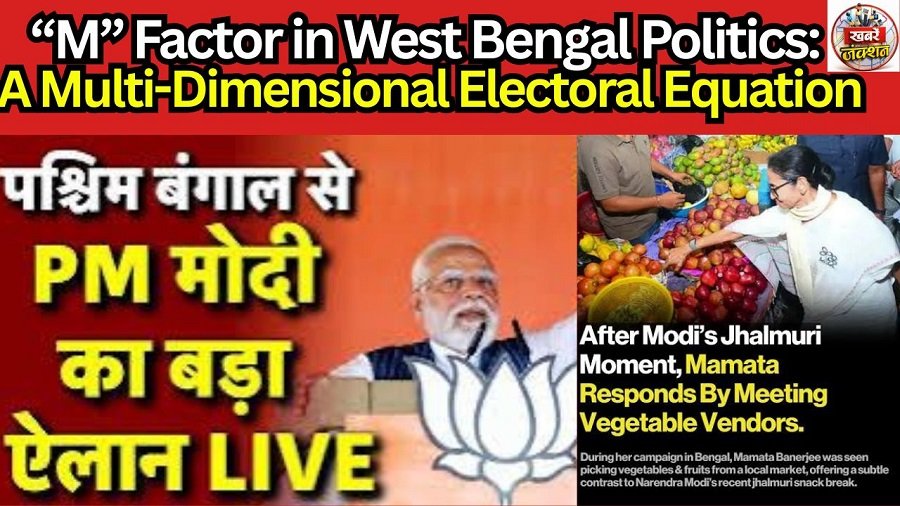
The first and most central “M” is Mamata Banerjee. She remains the most influential face of state politics. Her “Didi” image, simplicity, and grassroots connect have made her immensely popular among the masses. Her slogan “Maa, Maati, Manush” is not merely a political catchphrase but a deeply emotional connection with the people.
The second “M” is Narendra Modi. His national leadership has emerged as a strong alternative force in Bengal politics. The Bharatiya Janata Party has crafted its strategy around development, nationalism, and central welfare schemes under his leadership.
The third and fourth “M” are Muslim and Minority. In West Bengal, Muslim and other minority communities play a decisive role in many constituencies. This is why both major political formations are consistently trying to appeal to this voter base.
The fifth “M” is Mahila (Women). Women voters are once again at the center of intense political competition. Welfare schemes introduced by Mamata Banerjee, such as Lakshmi Bhandar, have strengthened her support base among women, while the BJP has also attempted to attract them through promises of financial assistance and empowerment initiatives.
The sixth “M” is Matua. The Matua Mahasangha community holds significant influence in border districts and can impact electoral outcomes, particularly on issues related to citizenship and identity.
The seventh “M” is Money. The role of financial resources in elections is evident. Campaigning, rallies, and organizational strength all depend heavily on funding.
The eighth “M” is Media. In today’s era, media—especially social media—plays a crucial role in shaping public perception. Debates around influence and bias in mainstream media also remain a part of the electoral discourse.
The ninth “M” is Muscle Power (Organizational Strength). Grassroots mobilization, cadre strength, and local influence play a decisive role in determining electoral outcomes. The long-standing presence of the ruling party has given it a strong organizational base, particularly in rural areas.
The tenth “M” is Mosque. Statements by leaders such as Humayun Kabir regarding mosque-related issues often give a religious dimension to the political discourse, strengthening identity-based politics.
The eleventh “M” is Fish. Fish is an integral part of Bengal’s culture and lifestyle. The instance of Anurag Thakur being seen eating fish drew attention, highlighting how political messaging adapts to local cultural contexts.
The twelfth and thirteenth “M” are Maa, Maati, and Manush—the core philosophy of Mamata Banerjee’s politics:
Maa (Mother): Represents compassionate governance and welfare
Maati (Soil): Symbolizes regional identity and connection to the land
Manush (People): Reflects dignity, participation, and respect for the common citizen
Together, these three create a powerful emotional and political foundation that has deeply influenced the state’s politics.
Overall, the contest appears extremely close. On one hand, Mamata Banerjee’s regional appeal and strong hold over women and minority voters give her an advantage. On the other hand, Narendra Modi, along with the BJP’s organizational strength, resources, and national narrative, presents a formidable challenge.
It is evident that the party which successfully balances these “13 M factors” will come closest to power. Current trends suggest a tilt toward regional sentiments and the “Maa, Maati, Manush” narrative, potentially favoring the ruling side. However, the final verdict lies with the voters—who will ultimately decide which “M” they endorse, which leadership they trust, and which party they choose to govern.