
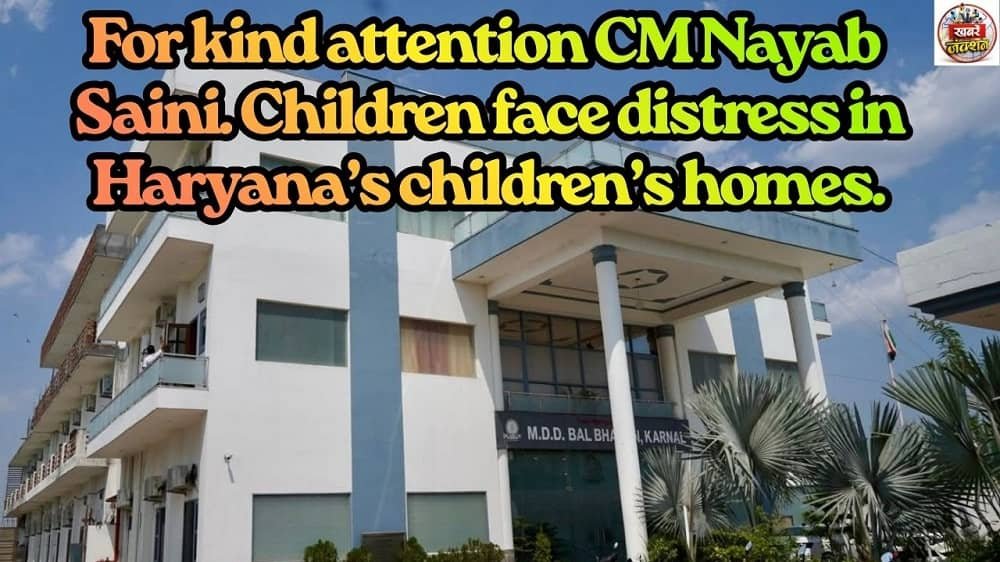
For kind attention CM Nayab Saini… Children face distress in Haryana’s children’s homes.
Gustakhi Maaf Haryana-Pawan Kumar Bansal
For kind attention CM Nayab Saini. Children face distress in Haryana’s children’s homes.
Haryana, counted among India’s most prosperous states, is facing an uncomfortable paradox. While its economy continues to expand and revenues remain robust, dozens of children’s homes across the state are struggling to survive due to non-payment of government grants.
There are about 35 children’s homes currently in operation in Haryana. Of these, 22 receive government grants at the rate of Rs 3,000 per child per month. These institutions function under the supervision of District Child Welfare Committees, which refer children to them under the provisions of the Juvenile Justice Act.
The grants, meant to cover food, accommodation, education, healthcare, clothing and other basic needs, were due to be released by March 31. However, the funds have not been disbursed so far, leaving many of these homes in financial distress.
Officials in the state government have reportedly conveyed that there is a shortage of funds, and that the treasury is unable to meet the commitment at present. This has come as a shock to administrators of children’s homes, many of whom have been operating on credit for months in anticipation of the annual grant.
In addition to maintenance grants, the government is also responsible for paying the salaries of certain staff members in these homes. Delays in these payments have compounded the crisis, affecting not only the quality of care but also staff morale.
Administrators say that the current grant amount itself is inadequate. At Rs 3,000 per child per month, the allocation translates to just about Rs 100 per day, which must cover all expenses, including food, school fees, medical care and other essentials. Despite these constraints, most homes have managed to function through a combination of donations, credit arrangements and cost-cutting measures.
The present delay, however, has pushed many to the brink.
Several homes have reported that suppliers of essential commodities such as food grains, milk and vegetables are beginning to demand payment. Educational institutions have started pressing for pending fees, while medical expenses are becoming increasingly difficult to manage.
“These are not discretionary expenses. They are basic necessities,” said an administrator of a children’s home in the state. “We cannot tell a child to wait for food or medicine because the government has not released funds.”
The situation is particularly concerning because the children housed in these institutions are among the most vulnerable. They include orphans, abandoned children and those rescued from difficult circumstances. Once admitted, they depend entirely on the system for their survival and development.
Under existing rules, children can stay in such homes until they turn 18. Some institutions, with special permissions, allow them to remain until the age of 21 to ensure a smoother transition into independent life. During this period, they are provided education, vocational training and life skills.
Many homes have taken significant initiatives to equip children with employable skills, including tailoring, beauty services and other trades. Some have also collaborated with organisations working to prevent child marriage and promote education, aligning their efforts with government programmes such as “Beti Bachao, Beti Padhao” and Skill India.
Despite their contribution to social welfare, these institutions now find themselves struggling due to administrative delays.
The funding gap has also highlighted a broader issue of financial management within the state. According to sources, there have been instances in the past where substantial funds earmarked for welfare programmes remained underutilised. This raises questions about the prioritisation and allocation of resources, especially when critical sectors like child welfare are affected.
Observers note that the current crisis is not merely a matter of delayed payments but a test of the state’s commitment to its most vulnerable citizens.
For the children in these homes, the impact of the delay is immediate and tangible. It affects their nutrition, education and overall well-being. For administrators, it means making difficult choices about how to stretch limited resources without compromising on care.
Experts warn that prolonged delays could lead to a breakdown of the support system, forcing some homes to scale down operations or, in extreme cases, shut down. This would place an additional burden on an already strained child welfare infrastructure.
The issue has also drawn attention through an open letter addressed to Chief Minister Nayab Singh Saini, urging the government to release the pending funds without further delay. The letter emphasises that for these children, the grants are not just a budgetary provision but a lifeline.
“It is the difference between a full plate and an empty one,” the letter states, appealing to the Chief Minister to intervene and ensure that the funds are disbursed at the earliest.
The appeal also underscores the contradiction of a financially strong state being unable to meet relatively modest obligations towards child welfare. It calls for urgent action to prevent the situation from deteriorating further.
As of now, there has been no official timeline announced for the release of the funds. Meanwhile, children’s homes continue to operate under increasing strain, relying on goodwill, credit and the hope that the government will act soon.
The coming days will be crucial in determining whether Haryana can address this crisis in time or whether its most vulnerable residents will bear the cost of administrative and financial lapses.