
Turned to Social Media: My Answer to a Journalism Student’s Question on Publishing Investigations.
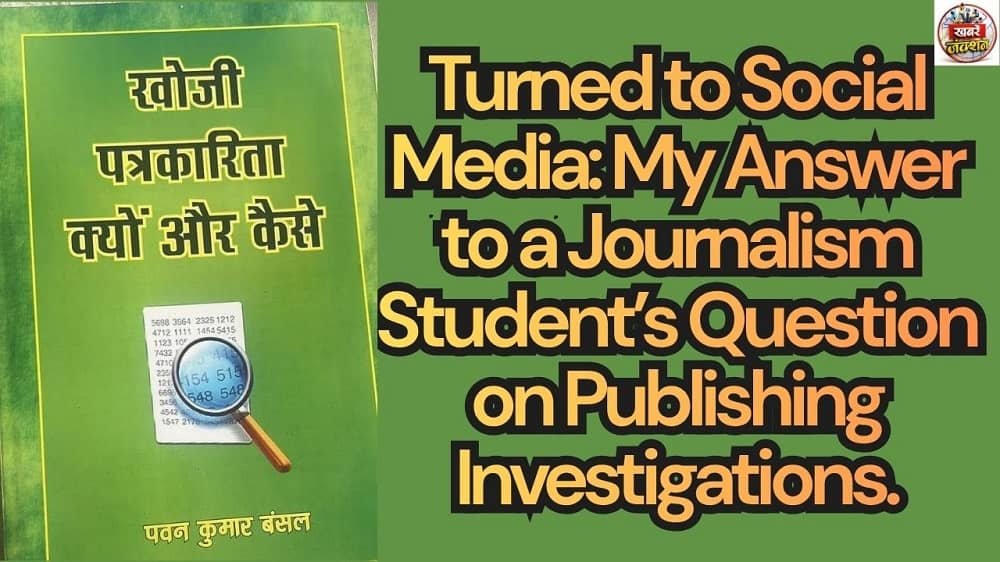
Gustakhi Maaf Haryana- Pawan Kumar Bansal.
The print and electronic media, it must be said, have increasingly failed in their duty towards readers and viewers. In this vacuum, social media has emerged as an alternative platform—despite its well-known drawbacks, particularly the absence of institutional checks. Alas, what choice remains?
While interacting with students of the Journalism Department at Guru Jambheshwar University of Science and Technology, Hisar, and speaking about the importance of investigative journalism, I was confronted with a question that left me momentarily speechless.
A young student asked, quite pointedly: “You advise us to pursue investigative journalism. But which newspaper or television channel will actually publish or broadcast such reports?” She went on to cite several instances where reporters, despite having strong evidence, failed to get their stories carried by their respective organizations.
It was a valid and deeply unsettling question.
For a moment, I had no answer. I recalled my own time with the Indian Express Group, where I had the privilege of working with complete editorial freedom. Even when influential individuals lodged complaints against me, my editors—Prabhash Joshi and Om Thanvi—stood firm, often dismissing such pressures without hesitation.
Regaining my composure, I responded as best as I could. Sensing the determination and potential in the young student—who, I believe, could become an outstanding investigative journalist—I suggested that she turn to social media as a platform.
Yes, social media is fraught with its own limitations, most notably the lack of regulation and accountability. Yet, in times when traditional media platforms appear constrained, it may well be the only avenue left for truth to find its voice.
Alas, what else can be done?