
650-Acre Ecological Treasure Under Pressure: Old Warnings Turn Relevant Again
Gustakhi Maaf Haryana- Pawan Kumar Bansal
Four years back our enlightened reader Jaibhagwan Hooda had warned about rampant encroachments in Aravali hills.Read old report which is more relevent today .In Mangarbani with Ranbir Singh Phogat and Sunil Harsana
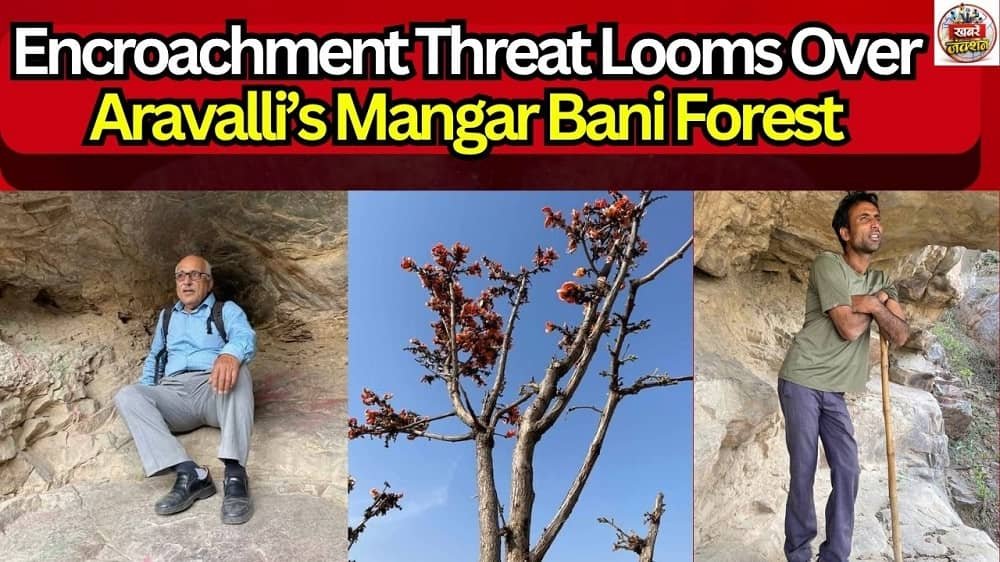
Located along the Delhi-Haryana border, between Faridabad and , this 650 acre forest is something of an ecological relic that somehow survived despite the builders, bureaucrats, politicians efforts to encroach upon it. We reached at Sunil house in Mangar at 7.00 AM as day before he gladly accepted to accompany us.
Shri Ranbir Singh Phogat descended one day before from Rohtak is is great traveller working on environment ,monuments rivers,dams ,villages history,restoration of chaupal ,old village wells,bawri and everything. I soak in its undulating terrain, ancient trees, and rocky landscape, reminded that I am amidst the folds of one of the oldest mountain ranges in the world, the Aravalis that start near Delhi and end all the way in Gujarat.
A little over an hour from Connaught Place in Delhi and equally from Gurugram, Mangar Bani is a dry, deciduous forest that transforms into a magical green during the monsoon. There are dhau trees, as well as dhak, raunjh, kumuth, pasendu, chirhaul, barna and kareel, local species of flora that shelter hyenas, leopards, porcupines, jackals, and monitor lizards, among hundreds of other animals. Mangar Bani and its adjoining green patches are a critical water-catchment area for Gurugram and Faridabad, and the last few green lungs of India’s choking capital city and NCR.
One of the main reasons that the Bani has survived, is because of the legend attached to it. Local pastoralists believe that it is a sacred grove protected by the spirit of the mystic Gudariyadas Baba, and any attempt to cut trees here will invite the Baba’s wrath.
The other reason it has survived is conservation work done by people like Sunil Harsana. Born in a village in Mangar, Sunil is an environmental activist who has been working towards conserving the region’s natural history for around 10 years now. He is the founder of the Mangar Eco Club, created in 2015, to introduce local and urban children to the biodiversity of the forest. He has been documenting the species here for the past six-seven years, and can rattle off the names of the diverse flora and fauna that inhabit this informal sanctuary. I have visited Mangar several time but personally met Sunil yesterday only . I knew about his work. Members of the Mangar Eco Club spend their weekends in their beloved forest, observing its wealth of biodiversity.
Sunil tells me that he conducts outreach programmes on holidays. This arrangement works well. The kids have a role model in Sunil, who like them grew up in these forests, and has a healthy love of all things wild. Sunil in turn enjoys working with the children, and is “certain that their love for these forests will translate into a will to protect it in the future.”
By reconnecting the children with the biodiversity of Mangar Bani he is reviving the link between the community and their forest.
More than 245 species of birds, 20 species of mammals, and around 300 species of trees have been recorded here, and Sunil tells me the forest cover has increased since mining within the forest stopped in 2007. “Nature is self-repairing,” he says, “The forest is resurrecting itself and the population of wildlife is increasing, but the land-use change in the surrounding areas needs to be controlled.” The conversion of forest land to real estate is a serious concern, and is damaging the biodiversity and geology of the Aravalli ranges.
Sunil’s work extends far beyond nature walks. In addition to the eco club, he also nurtures the forest by assisting Forest Deptt for building check dams before the monsoon every year, to prevent the erosion of soil. “If I see any illegal activities such as logging of trees happening in the surrounding forests, I report it to the forest department. If the department doesn’t take any action, I talk to the media and higher authorities,” he says.
Sunil knows that protection offered by local beliefs is not absolute. Since 2010 he has been fighting a battle for Mangar to be given forest status. He realises that his biodiversity documentation work is crucial towards this end, and is hopeful that revealing the splendours of this forest will convince the government to declare it a protected area.
The region was declared a no-construction zone in 2016, which has helped, but the encroachment of land for construction activities continues to plague the Aravalli Hills around Mangar Bani. Many organisations supports Sunil’s work, The very vulnerable forest of Mangar is subject to degradation, encroachment, and ‘development’ interests, despite being one of very few green patches that provides invaluable ecosystem services to the ” Sunil’s work is in the interest of citizens of Delhi,Gurgaon and Faridabad. “Sunil is a home-grown conservationist, and his relentless efforts to restore and protect the forest is inspiring.It’s not just Mangar Bani that’s at stake. Sunil, who has explored the landscape extensively, states that there are areas in the surrounding forests where wildlife populations are thriving, but the government has proposed new roads through these areas. “The consequence of these roads will be human-wildlife conflict,” he laments. Protecting ecosystems such as Mangar Bani from the onslaught of urbanization is crucial for the health of people living in the National Capital Region. Sunil works with a number of stakeholders, from locals in and around Mangar Bani, to citizen groups, activists, and journalists, to draw attention to the plight of this forgotten wilderness. “We engage with villagers, urbanites, and government departments. We try to talk to villagers initially. If an issue is not getting resolved, we talk to those from the city and the concerned government departments.”
I found Sunil as a rare breed of conservationists.
Walking through the forest, I ponder over how local beliefs have shaped conservation in this region, and shaped Sunil’s relationship with the Bani. This little forest, engulfed on all sides by a fast-expanding city, is protected largely due to the sacred status afforded to it by locals. The surrounding forests do not enjoy this status, and they are sadly being encroached upon.
I take a deep breath of the clean air, feel the coolness of the wind, and hope for a larger Bani, that encompasses the surrounding hills.