
Why am not writing about allegations of Subramaniam and Madhu Kishwar against PM Modi?
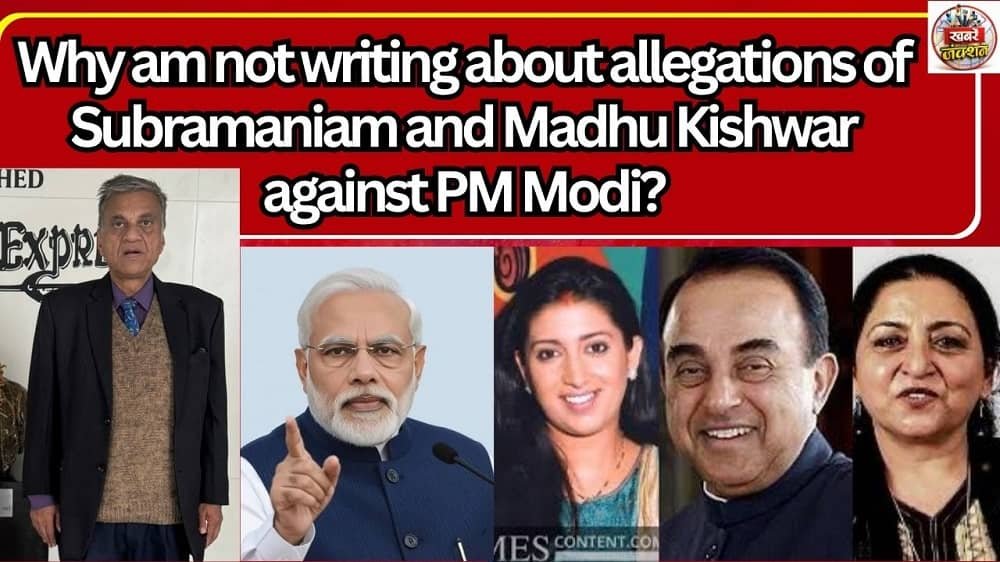
Gustakhi Maaf Haryana-Pawan Kumar Bansal .
Recent allegations made by Subramanian Swamy and journalist Madhu Kishwar concerning Prime Minister Narendra Modi have generated considerable public interest. Some readers have also asked why this issue has not been addressed in this column so far.
At the outset, it may be clarified that this column does not rely on unverified or second-hand accounts. Its approach is grounded in independent assessment and verifiable information.
Dr. Swamy has made serious allegations of misconduct, referring to certain women Members of Parliament. Given the gravity of such claims, they require clear and credible substantiation. In such situations, it is reasonable to expect that any available evidence would be presented through appropriate legal channels. Even if there are concerns about the registration of a case, judicial avenues remain open, particularly to individuals well-versed in legal processes.
Similarly, Madhu Kishwar has raised comparable concerns, drawing upon Dr. Swamy’s assertions. She has also questioned the appointment of Smriti Irani as HRD Minister, citing her educational background. However, academic qualifications alone may not fully determine an individual’s effectiveness in public office, as administrative capability can be shaped by a range of factors beyond formal education.
It is important to clarify that this column does not seek to defend or oppose any individual. Rather, it underscores a broader principle: serious allegations must be supported by evidence, and any conclusions should follow due process.
As a matter of context, the author’s perspective is informed by long experience in investigative journalism, where emphasis has consistently been placed on documentation, verification, and accountability.
In matters of public importance, particularly those involving high office, restraint and adherence to institutional processes are essential. Public discourse is best served when it is guided by evidence rather than conjecture.