
“Hinsa ke duar mein shaanti ki baat karti ek kitaab”
Mahilayen, Kaam Aur Shanti by Ela Bhatt Translated by Neelam Gupta.
Gustakhi Maaf Haryana – Pawan Kumar Bansal
Book Release
“A Book of Lived Experience and a Ray of Hope” — Shri Ram Bahadur Rai
New Delhi, 24 February
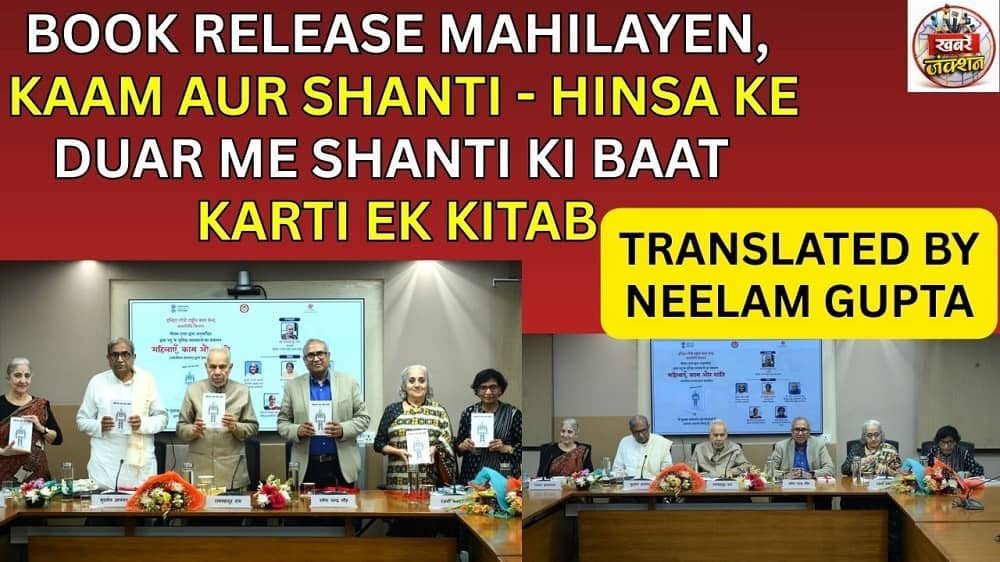
The book Mahilayen, Kaam Aur Shanti was launched at the Indira Gandhi National Centre for the Arts (IGNCA), New Delhi. Authored (translated) by Neelam Gupta, the first copy was dedicated to Ela Bhatt and symbolically handed over to Renana Jhabvala as her dharoher (legacy). The book is the Hindi translation of Women, Work and Peace by Ela Bhatt.
The Kalanidhi Division of the Indira Gandhi National Centre for the Arts (IGNCA) organised the release and discussion of the book. The publication is a curated collection of select lectures by the renowned thinker Ela Bhatt, translated into Hindi by senior journalist and writer Neelam Gupta. The book has been published by Navjivan Sahitya. The programme was chaired by Shri Ram Bahadur Rai, Chairman of the IGNCA Trust. Speakers at the discussion included Rajni Bakshi, noted journalist and social activist; Sudarshan Iyengar, former Vice-Chancellor of Gujarat Vidyapeeth; Prof. Ramesh Chandra Gaur, Head (Kalanidhi) and Dean, IGNCA; Renana Jhabvala, eminent social entrepreneur and activist; as well as the translator of the book, Ms Neelam Gupta.
Chair’s Address
Speaking as the Chair, Shri Ram Bahadur Rai remarked that the book is not merely a collection of words, but a distillation of lived experiences gathered by Ela Bhatt through decades of engagement with society. He observed that these experiences are expansive, “like the vast sky,” and that the message of the book is not confined to India alone but extends to the broader concerns of South Asia, particularly the condition of women in the region. He noted that microfinance remains one of Ela ji’s most significant contributions to society. He also emphasised the importance of gaining control over both body and mind, reiterating that to truly remember Ela ji, decisions must be taken from the heart rather than merely the mind. Concluding his remarks, he urged everyone to read the book, stating that in times marked by distress and despair, Ela ji’s thoughts and this book emerge as a ray of hope.
Renana Jhabvala’s Remarks
Renana Jhabvala, National Coordinator of the Self-Employed Women’s Association (SEWA), recalled her first meeting with Ela Bhatt in 1977, describing it as a turning point in her life. She shared that she discontinued her Ph.D. to return to India and work alongside Ela ji, inspired by her vision and commitment. Reflecting on SEWA’s foundational philosophy, she said that thought, work, and values form its core principles, with work always at the forefront.
She emphasised that Ela ji believed poverty itself is a form of violence and that work is central to dignity in poor households. She highlighted the need to engage with mainstream economic structures, explaining how garments produced by women in India move through global supply chains to markets such as New York, making engagement with institutions like the International Labour Organization essential.
She described the creation of global networks such as Women in Informal Employment: Globalizing and Organizing (WIEGO), StreetNet International, and HomeNet International to create pathways for informal women workers. Using the metaphor of a broom’s life cycle—natural, circular, regenerative—she illustrated the ecological thinking embedded in Ela Bhatt’s everyday work.
Recalling difficult times, including the Gujarat riots, she noted how women created shared spaces for dialogue across religious divides. As SEWA completed 50 years (1972–2022), she emphasised that unity and shared principles have sustained the movement. Stressing the importance of the Hindi translation of Women, Work and Peace, she said it would guide SEWA sisters in their work and decisions for the next 50 years, as it serves as a written source of Ela Bhatt’s core vision and principles.
Sudarshan Iyengar’s Address
Sudarshan Iyengar began with Rahim’s couplet:
“Jahan kaam aave sui, kahan kare talwar.”
He explained that a needle may pierce, but it does so to mend; gentleness is not weakness, but strength and skill. Women, he said, have often been ahead of their times.
He noted that the book’s title is apt, reflecting the emergence of a women-oriented economic system built through collective strength and shared labour. Emphasising SEWA’s work, he remarked that a quiet yet profound revolution for peace has begun at the grassroots. Situating Ela ji’s thought in a broader socio-economic context, he stated that she challenged conventional notions of security, asserting that food alone does not constitute true security; dignity of work, collective empowerment, and social justice are central to a humane society.
He added that Ela Bhatt combined speech and action—vani and karma—and congratulated Neelam Gupta for bringing her words and actions to a wider audience. He concluded that Ela Bhatt’s journey represents a movement from the world of a
ction to the world of knowledge, and her voice must be amplified further.
Rajni Bakshi’s Views
Rajni Bakshi observed that Mahatma Gandhi’s philosophy of non-violence should be understood not merely as a moral or political strategy, but as a foundational principle of civilisation. Referring to anthropologist Margaret Mead’s insight about a 1,500-year-old fossil with a healed broken arm as evidence of civilisation, she argued that compassion and care precede aggression in human history. She underlined that Gandhiji is not merely a source of inspiration but a source of strength, offering resilience and ethical clarity in confronting contemporary challenges.
Neelam Gupta’s Reflections
Translator Neelam Gupta stated that the book is not a compilation of written essays but a curated collection of 27 speeches delivered by Ela Bhatt at eminent national and international forums. She read excerpts from some of them during the event.
She explained that Ela Bhatt wanted the book in Hindi so her thoughts could reach over 2.5 million SEWA sisters, who have become socially and economically self-reliant through SEWA’s principles. Ela Bhatt believed that if development is to be non-violent, inclusive, coordinated, and sustainable, this book would serve as a guide for women in the unorganised sector.
Neelam Gupta noted that Ela Bhatt entrusted her with translating Women, Work and Peace into Hindi in April 2022 during SEWA’s 50-year celebrations. A few months later, Ela Bhatt passed away. Her son, Mihir Bhatt, ensured the Hindi version was published by Navjivan Trust in Ahmedabad. She dedicated the first copy to Ela Bhatt and symbolically handed one to Renana Jhabvala, calling her the key to understanding Ela Bhatt’s vision. She said emotionally, “Ela ben, akhir aapne yah kaam mujhse karwa hi liya.”
She added that translating Ela Bhatt’s concepts without her presence was challenging, but she made every effort to preserve the original spirit, sensitivity, and depth so that a wider Hindi readership could engage meaningfully with this intellectual tradition.
Welcome Address
Prof. Ramesh Chandra Gaur, Head (Kalanidhi) and Dean, IGNCA, in his welcome address, said the book presents a significant and thought-provoking discourse on women’s labour, social justice, and peace. He noted that although contemporary society increasingly recognises women’s active role, this was not always the case. The book invites reflection on this historical imbalance while highlighting the evolving role of women in shaping just and peaceful societies.
The programme was attended by scholars, researchers, and practitioners from the fields of art, culture, and social thought.
khabre junction