
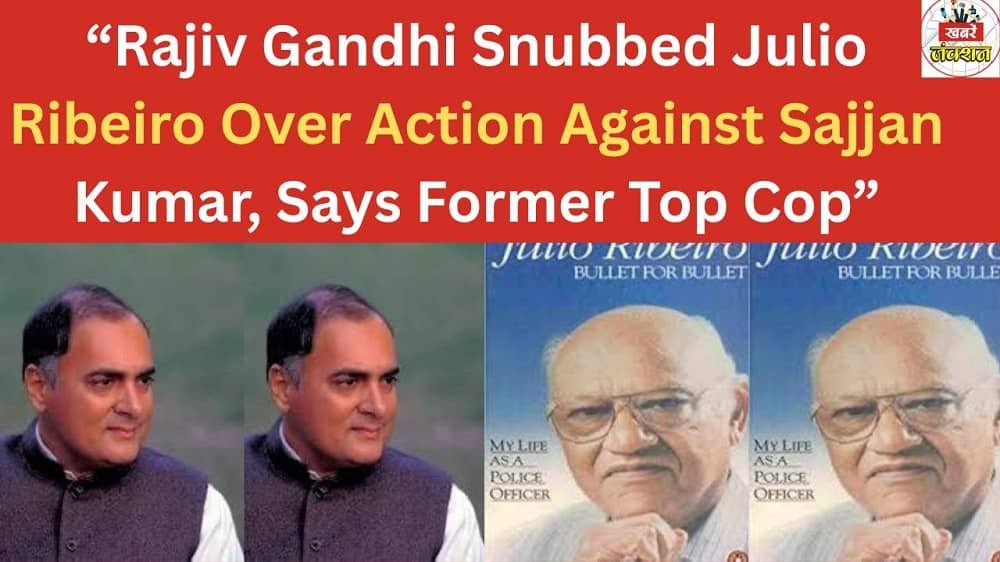
“Rajiv Gandhi Snubbed Julio Ribeiro Over Action Against Sajjan Kumar-Says Former Top Cop”
Gustakhi Maaf Haryana – Pawan Kumar Bansal
RAJIV HAD SNUBBED RIBEIRO WHEN ASKED FOR ACTION AGAINST SAJJAN KUMAR
Rahul Gandhi’s claim in an interview on a TV channel that the Congress and the Union Government had tried to stop anti-Sikh violence in Delhi in 1984, following the assassination of then Prime Minister Indira Gandhi, has been challenged by none other than Trilochan Singh, the then Press Secretary to the then President, Giani Zail Singh.
Sikh organisations allege that Congress leaders, including Sajjan Kumar and Jagdish Tytler, had instigated mobs to carry out violence against Sikhs. Even Randeep Surjewala, spokesperson of the Congress, was finding it difficult to defend Rajiv Gandhi, raising doubts over Trilochan Singh’s claims and adding that Singh had been a beneficiary of BJP rule, questioning the justification of raking up the issue after so many years.
Forget the claims of Trilochan Singh that Rajiv Gandhi did not even take calls from Zail Singh, who was shocked over reports of violence against Sikhs on the day of Indira Gandhi’s assassination. Even Julio Ribeiro, a top cop who had headed the Punjab Police during the peak of terrorism at grave risk to his life, alleged that Rajiv Gandhi had snubbed him when he advocated action against Sajjan Kumar at a high-level meeting held in Delhi to review the Punjab situation, presided over by Rajiv Gandhi himself.
Rajiv Gandhi had said that he could not allow the prosecution of Sajjan Kumar, a committed loyalist of the Gandhi family, merely because of some false allegations. Ribeiro also admits that there was no political will to conduct investigations professionally—a charge supported by retired Delhi Police officer Ved Marwah as well.
Ribeiro, in his book Bullet for Bullet, writes that he was the only officer who consistently advocated the prosecution of politicians accused of inciting mobs to kill Sikhs in Delhi. According to the top cop, initially Rajiv Gandhi did not react to what he said, but when he repeated his views for the third time, S.S. Ray, the then Governor of Punjab, advised him not to voice such sentiments again in the presence of Rajiv Gandhi.
Ribeiro further writes that he was not sure whether Rajiv Gandhi had asked Ray to communicate this to him or whether the Governor himself felt that Rajiv Gandhi did not like any reference to the issue. The top cop writes that he was not one to stay silent when convinced that a grave injustice was being done. He adds that he was fighting a difficult battle to win the hearts and minds of Sikhs, which he believed was essential to succeed in the war against terrorism.
Ribeiro reveals that once, taking advantage of Ray’s absence during a meeting with the Prime Minister—when Ray was called away to keep an appointment with the Chief Justice of the Supreme Court—he raised the issue of the Delhi riots and killings with Rajiv Gandhi. Rajiv Gandhi lost his temper, something that surprised and shocked Ribeiro, as Rajiv Gandhi had never lost his temper with him before.
According to Ribeiro, Rajiv Gandhi said that he did not want him to raise the matter again, as he could not agree to prosecute Sajjan Kumar, a committed Congress loyalist, merely because of some false allegations being made against him. Defending Sajjan Kumar, Rajiv Gandhi said that Kumar had remained beside the body of his mother throughout the time it lay in state, and that he himself was a witness to this fact.
The top cop writes that all the politicians and officers present in the meeting were shocked and remained silent. He adds that he thought it appropriate to point out to Rajiv Gandhi that since a commission had indicted Sajjan Kumar, prosecution would meet the required norms. He regrets that although Rajiv Gandhi was intrinsically a decent individual with good instincts and usually listened to him on most matters, on this particular issue he was influenced by the fact that Sajjan Kumar was a loyalist, totally committed to the Gandhi family, and his instincts told him that he could not let Kumar down.
Narrating another incident to show the level of confidence Rajiv Gandhi had in him, Ribeiro writes that two days after an armed man with a country-made gun had fired at him at the Gandhi Samadhi in Rajghat, Delhi, Rajiv Gandhi invited him to his residence for a one-to-one discussion about his personal security and requested him to appoint an officer to oversee it. Interestingly, until this meeting concluded, the then Minister of State for Home, Chidambaram, and Cabinet Secretary B.G. Deshmukh had to wait outside. However, Rajiv Gandhi did not like Ribeiro’s suggestions regarding Sajjan Kumar.
Ribeiro further writes that during his travels through Punjab’s villages and interactions with numerous Sikh villagers, he found that the massacre of Sikhs in Delhi following Indira Gandhi’s assassination, and the subsequent failure of the Congress government to arrest leaders who had instigated the riots, deeply troubled them.
He statesthat he was shocked by Rajiv Gandhi’s behaviour in the meeting on the Sajjan Kumar issue, noting that otherwise Rajiv Gandhi was a simple-hearted man and responsive to his suggestions on tackling militancy in Punjab.
The top cop writes that he regularly conveyed his observations about Sikh sentiments in Punjab to the then Governor S.S. Ray and to Prime Minister Rajiv Gandhi. However, Rajiv Gandhi acted on the advice of various confidants from time to time—initially Arjun Singh, later Arun Nehru until he fell out of favour, followed by S.K. Fotedar, then Buta Singh after he became Home Minister, and Chidambaram at a later stage. Besides them, many officers, including Cabinet Secretary G. Deshmukh, Principal Secretary to the Prime Minister Sarla Grewal, and M.K. Narayan, Director of the Intelligence Bureau, also advised him.
khabre junction