
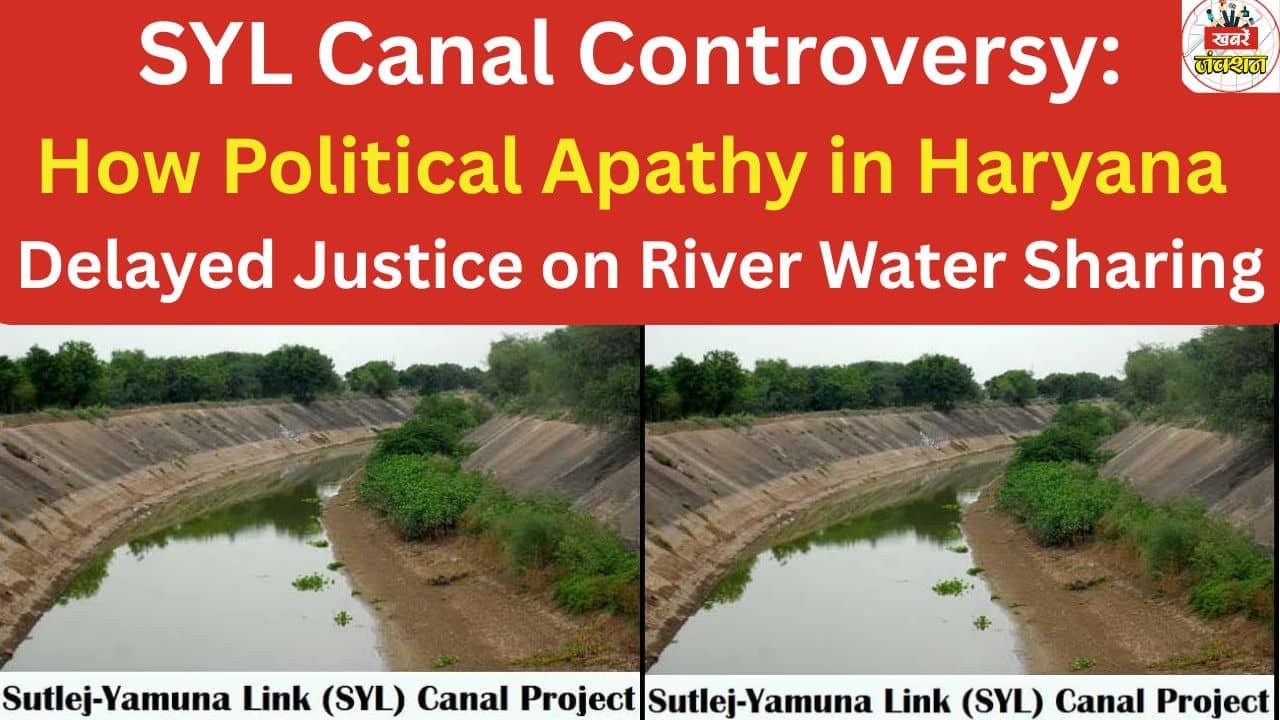
SYL Canal Controversy: How Political Apathy in Haryana Delayed Justice on River Water Sharing
Gustakhi Maaf Haryana – Pawan Kumar Bansal
By our enlightened reader and social activist Dr. Ram Kumar
The Rajiv–Longowal Accord contained three important clauses regarding the sharing of river waters. First, the water being used as on 1st July 1985 was to remain protected. Second, a Tribunal was to be appointed to decide the share of surplus Ravi–Beas waters among the concerned States. Third, Punjab was to complete the construction of the Sutlej–Yamuna Link (SYL) Canal by 15th August 1986. However, the manner in which Haryana was treated under this Accord raises serious questions of discrimination.
In protest against this Accord, a Sangharsh Samiti was formed under the leadership of Chaudhary Devi Lal, which launched a “Nyaya Yudh” (war for justice). Subsequently, when Surjit Singh Barnala became the Chief Minister of Punjab, he initiated land acquisition and started the construction of the SYL Canal on a war footing. As a result, nearly 90 percent of the canal work was completed by March 1987. Unfortunately, his government was dismissed at that stage, and the construction work came to a halt.
In accordance with Clause 2 of the Accord, the Ravi–Beas Tribunal headed by Justice Eradi was constituted. The Tribunal gave its Draft Award on 31st January 1987, allocating water shares among the States. On this Draft Award, the Ministry of Water Resources, Government of India, sought responses from the concerned State Governments. The response of the Punjab Government came in August 1987. By that time, one member of the Tribunal, Justice Ahmadi, had been appointed as a Judge of the Supreme Court, and subsequently the third member, Justice Memon, also left the Tribunal.
Due to these vacancies, the Tribunal could not finalize its Award, and the matter remains unresolved even today. What is more disturbing is that no successive government in Haryana ever took serious steps to get these vacancies filled so that the Tribunal could complete its work and deliver the final Award. This clearly shows that Haryana’s political leadership has, in reality, not been interested in resolving the river water dispute and has instead continued to mislead the people.
In this context, the statement of Punjab Chief Minister Bhagwant Mann appears logical and justified when he says that the share of water must be decided first, and only thereafter can the issue of construction of the SYL Canal arise. The real facts indicate that it is the leaders of Haryana who are responsible for the non-completion of the SYL Canal. Therefore, blaming the leaders of Punjab or its people for obstructing the completion of the SYL is neither fair nor based on facts.