
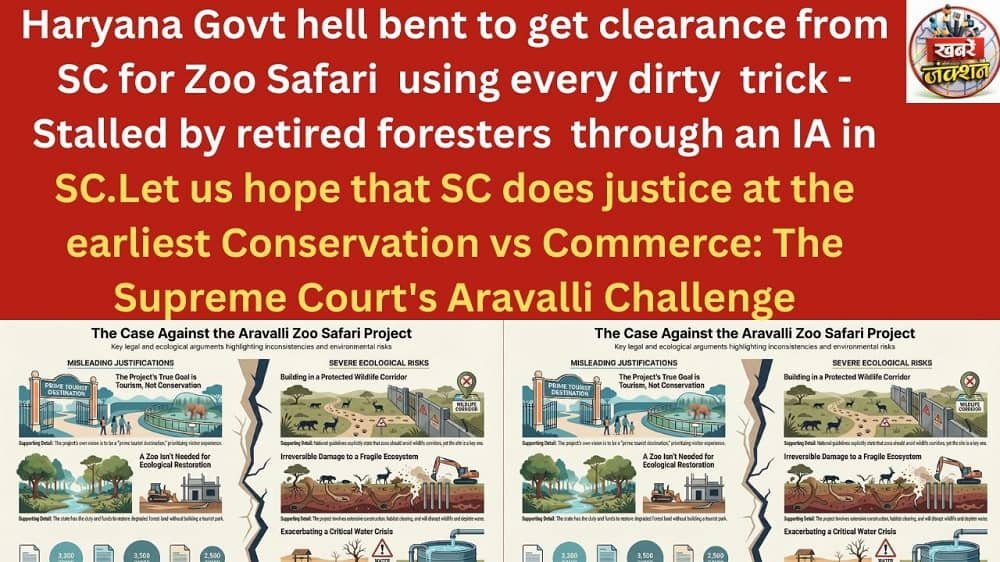
Haryana Govt hell bent to get clearance from SC for Zoo Safari using every dirty trick -Stalled by retired foresters through an IA in SC.Let us hope that SC does justice at the earliest Conservation vs Commerce: The Supreme Court’s Aravalli Challenge
Gustakhi Maaf Haryana – Pawan Kumar Bansal
By our enlightened reader Vinod Bhatia, Retired IFS Officer, Haryana
Hypothetical Fallouts in Seeking to Halt the Aravalli Zoo Safari Project:
Observations Submitted in the Supreme Court
The project’s vision and mission, as stated in the DPR, focus on becoming a “prime tourist destination” and providing “immersive wildlife experiences” for visitors, rather than on the intrinsic restoration of the Aravalli ecology. The Court will agree that the Aravallis are critically water-stressed. The project would involve extensive construction and human presence, which could deplete water resources, disrupt wildlife corridors (specifically the block connecting to the Asola Wildlife Sanctuary), and fragment habitats.
The rejoinder states that the project violates the MoEFCC Consolidated Guidelines 2023 because it lacks tree enumeration, has no visitor carrying capacity assessment, and is situated within a wildlife corridor. These are valid points, but the CEC is not expected to give any comment on this.
Based on the criticisms and deficiencies highlighted in our petition and rejoinder, the following requirements would be necessary for the project if it clears the Supreme Court hurdle. We must stress that the State should complete and publish the following:
Tree Enumeration and Vegetation Mapping: As required by Clause (vi) of the guidelines, to ascertain exactly how many trees will be felled.
Visitor Carrying Capacity Study: To ensure that human footfall does not exceed the environment’s ability to recover.
Water Impact Assessment: A detailed plan explaining how the water demand (initially estimated at 10 cusecs) will be met without further stressing the local water table.
If it appears that the case is not proceeding in our favour, then we can press for certain safeguards as demands before the Supreme Court, such as:
The project should be moved away from the contiguous forest habitat that serves as a corridor between Delhi, Haryana, and the Sariska Tiger Reserve, to prevent habitat fragmentation and human–wildlife conflict.
All versions of the DPR, feasibility reports, and correspondence regarding compensatory afforestation should be placed in the public domain. This will ensure that environmental experts and the public can provide informed feedback on the project’s scope.
The State must reconcile the project’s land use with the Great Nicobar Island compensatory afforestation scheme to ensure that forest land is not being “double-counted” for different environmental obligations.
The State of Haryana’s affidavit appears to exploit specific technical and procedural gaps in our petition.
Ambiguity of Phased Development: The State argues that the project is currently limited to 3,300 acres, whereas the claim is 10,000 acres. The weakness here is that the State has produced multiple letters and a revised DPR indicating a reduced scope for “Phase I”. Legally, it is difficult to challenge a future “Phase II” that has not yet been formally sanctioned or funded.
Concession on Land Degradation: We admit that parts of the Aravallis are “highly degraded” due to mining. The State leverages this to frame the Zoo Safari as an ecological restoration initiative. By acknowledging the degradation, we inadvertently support the State’s claim that some intervention is necessary, leaving the “type” of intervention (zoo versus natural restoration) to administrative discretion.
Correction of ‘Double-Counting’ of Land: The State has submitted internal correspondence (dated March and April 2025) requesting the exclusion of safari land from the Great Nicobar Island (GNI) compensatory afforestation scheme to “avoid duplicity of works”. This allows the State to claim that it is proactively fixing the overlap, potentially neutralising the petitioners’ strongest argument regarding the illegal “double-counting” of forest land.
Technical Compliance vs. Subjective Interpretation: While we cite violations of the 2023 Consolidated Guidelines, many of these (such as “Desirables” and “Non-Desirables”) are interpretative. If the Central Zoo Authority (CZA) takes a favourable view, these objections may be diluted.
Tailpiece:
This is typically a case of conservation versus commerce, and as a citizen of the NCR, I sincerely hope that the Hon’ble Supreme Court will not choose the latter. The Supreme Court now faces an Aravalli challenge, one that it must decide in the interest of the public at large, and not for petty politicians and their collaborating builder mafia.
khabre junction