
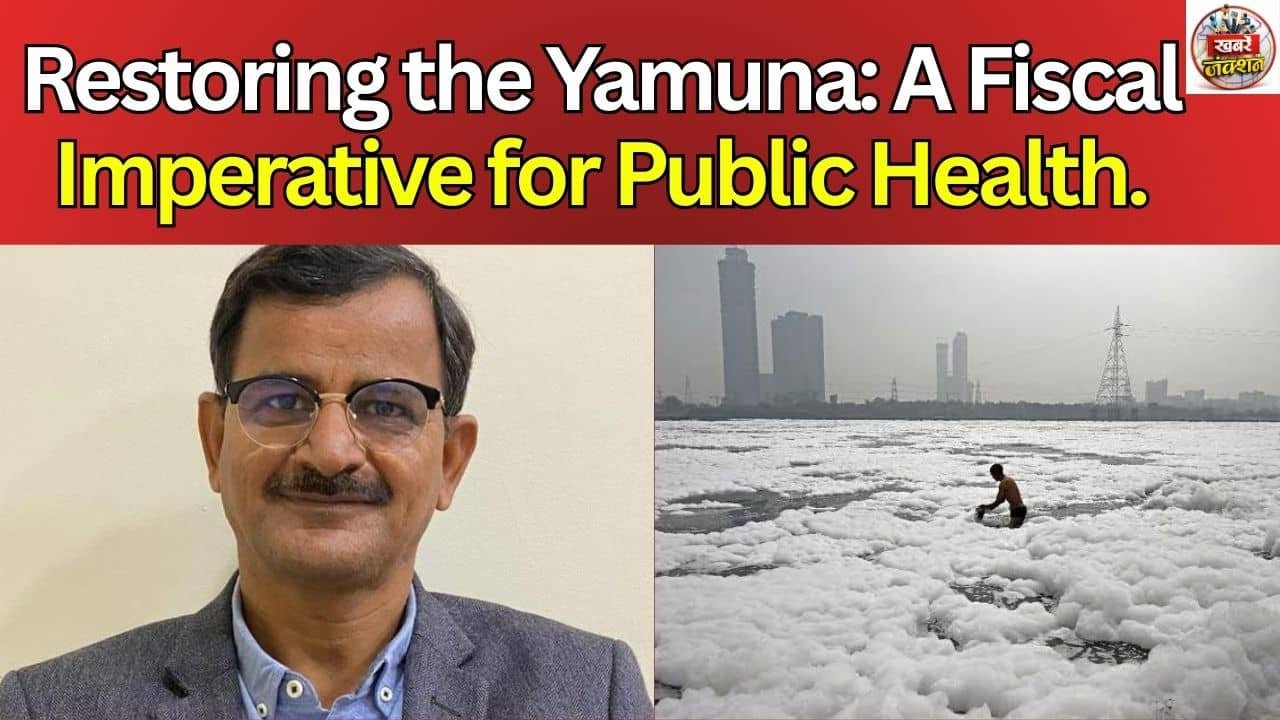
Restoring the Yamuna: A Fiscal Imperative for Public Health.
Gustakhi Maaf Haryana – Pawan Kumar Bansal
By our enlightened reader, Retired SE, Haryana Irrigation and Water Resources Department & Convener, Walk for Yamuna Campaign
Yamuna at the Crossroads: A Budgetary Reckoning for Water Security and Public Health
The Yamuna River stands today at a defining moment. Once revered as a life-giving river, it now mirrors the contradictions of our development model — expanding cities, shrinking floodplains, and rising pollution. As governments at the Centre, Haryana, and Delhi finalise budgetary priorities, the true test of governance will not lie in expressways or skylines, but in whether clean and sufficient Yamuna water is secured for the millions who depend on it.
Water security is no longer an environmental slogan; it is a public health and economic imperative.
For Haryana, the Yamuna represents both responsibility and reform. A substantial pollution load entering Delhi flows through industrial and urban centres such as Panipat, Sonipat, Faridabad, and Gurugram. Untreated sewage, textile effluents, and poorly regulated drains continue to degrade river quality. Budgetary provisions must therefore move beyond incremental allocations and commit to measurable outcomes — 100 per cent sewage treatment with zero untreated discharge, real-time monitoring of industrial effluents, time-bound interception of drains before they meet the river, and restoration of wetlands and floodplains as natural buffers.
The situation is particularly concerning in canal-dependent belts where irrigation relies on water released from the Okhla Barrage along the Yamuna. Deteriorating water quality in these canals directly affects agriculture, contaminates the food chain, and raises rural health risks. Protecting the river, therefore, is inseparable from protecting livelihoods and public health.
Delhi’s accountability is equally central. The national capital depends heavily on Yamuna waters for drinking supply, yet the river within the city often resembles a wastewater channel. The budget must prioritise decentralised sewage treatment in unauthorised colonies, completion of interceptor sewer systems, urgent replacement of ageing water and sewer pipelines, and mandatory reuse of treated wastewater. A publicly accessible real-time water quality dashboard would bring much-needed transparency and restore public trust.
The groundwater crisis adds another layer of urgency. Findings of the Central Ground Water Board indicate elevated nitrate, uranium, and high TDS levels in several parts of Delhi–NCR, reflecting overdependence on stressed aquifers. Excessive concretisation and encroachments have destroyed natural recharge zones, causing floods during monsoons and scarcity during summers. The crisis is not merely hydrological; it is the outcome of distorted land use and weak institutional coordination.
The budget must therefore mark a decisive transition from conventional grey infrastructure to regenerative, nature-based solutions.
First, induced groundwater recharge should be scaled up through mandatory rainwater harvesting across all urban properties. Underground floodwater storage reservoirs beneath parks and stadiums — inspired by innovations in Singapore, Tokyo, and Israel — can convert floods into future water reserves.
Second, deep underground sewer tunnel networks, similar to the systems that aided the revival of the River Thames in London, should be developed to prevent untreated sewage from entering rivers. Simultaneously, replacement of leaking pipelines must be treated as urgent infrastructure reform rather than routine maintenance.
Third, cluster-based rejuvenation of ponds, wetlands, and canal systems must be undertaken alongside large-scale native afforestation along the Yamuna floodplains and the Aravalli Range. Nature-based wastewater treatment systems — including constructed wetlands and bio-remediation corridors — offer sustainable and cost-effective alternatives to purely mechanical plants.
Fourth, technology must strengthen governance. Real-time monitoring of water quality, groundwater levels, and flood risks through digital dashboards can enhance transparency. Adoption of the “Sponge City” concept pioneered in China, and integration of Blue–Green Infrastructure — linking parks, green corridors, and urban forests with rivers, lakes, and wetlands — can reduce flood risks, improve water quality, enhance biodiversity, and promote community well-being.
Finally, accountability must be institutionalised. Funding from national programmes such as the Jal Shakti Abhiyan and Jal Jeevan Mission should be linked to measurable performance indicators. Digital platforms must clearly fix responsibility on departments and officials to ensure that negligence carries consequences.
The Yamuna’s decline is not inevitable; it is a policy choice. Budgets have the power to reverse this trajectory — but only if they are guided by science, sustainability, and public interest rather than short-term optics. Clean and sufficient Yamuna water must become a time-bound national commitment backed by transparent financing and enforceable targets.
If rivers are allowed to decline, cities will follow. The choice before policymakers is stark: continue managing crises or invest in lasting reform. The Yamuna cannot wait — and neither can the millions whose lives flow with it.
Water cannot wait. If budgets truly reflect priorities, the Yamuna must come first.