
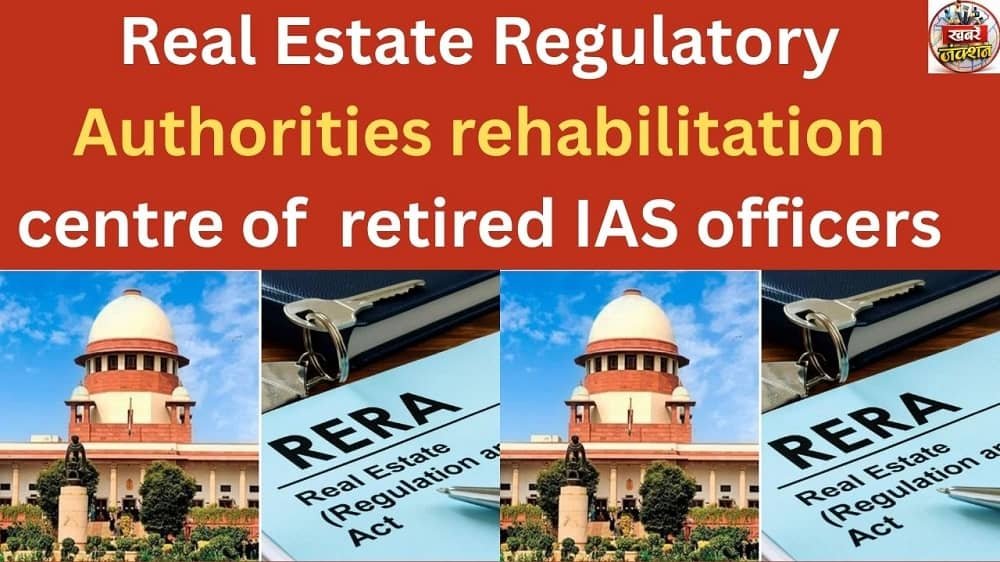
Real Estate Regulatory Authorities rehabilitation centre of retired IAS officers
Gustakhi Maaf Haryana – Pawan Kumar Bansal
Supreme Court of India’s Strong Observations on Real Estate Regulatory Authority Echo Concerns Raised by Dr. Akhil Mahajan
In a development that may reignite debate over the effectiveness of the Real Estate Regulatory Authorities (RERA) across the country, the Hon’ble Supreme Court has made sharp observations questioning the present functioning of RERA bodies. The Court reportedly remarked that the institution, originally envisioned as a strong regulator to protect homebuyers, has failed to deliver meaningful relief in several states.
The remarks resonate with long-standing concerns raised by real estate reform advocate Dr. Akhil Mahajan, who has previously described RERA as a “toothless tiger” in its current form. According to him, the regulator has increasingly become ineffective due to structural and administrative limitations.
Legal observers note that the Court’s comments highlight a growing perception that RERA authorities are not adequately addressing the grievances of homebuyers. Critics argue that, in many instances, the bodies are dominated by retired bureaucrats, leading to what some activists describe as a “rehabilitation model” rather than a performance-driven regulatory framework.
Dr. Mahajan has consistently advocated for structural reforms in RERA, emphasizing that homebuyers—the primary stakeholders—must be given representation in policy formulation and regulatory decision-making. “Unless the voices of homebuyers are institutionally embedded, the regulator risks drifting away from its core purpose,” he has said in previous public interactions.
Experts also underline the need for greater domain expertise within RERA authorities. Urban planners, technical specialists, and independent subject-matter experts should form part of the regulatory structure to ensure balanced and informed decisions. Such multidisciplinary representation, they argue, would help bridge the gap between policy intent and on-ground realities in the housing sector.
The call for reforms comes at a time when India’s real estate market is undergoing rapid expansion and urbanisation. Analysts believe that a robust and accountable RERA framework could play a critical role in restoring buyer confidence, improving transparency, and accelerating sustainable economic growth.
With the Supreme Court’s observations now adding judicial weight to long-standing public concerns, the spotlight is firmly back on the need to revisit and reform the RERA framework. Stakeholders across the housing ecosystem are likely to watch closely whether these developments translate into concrete policy changes aimed at strengthening buyer protection and restoring faith in the regulatory regime.
khabre junction