
Panjab University Under Seige :Autonomy, Confusion and the Crisis of Faith
Gustakhi Maaf Haryana- Pawan Kumar Bansal
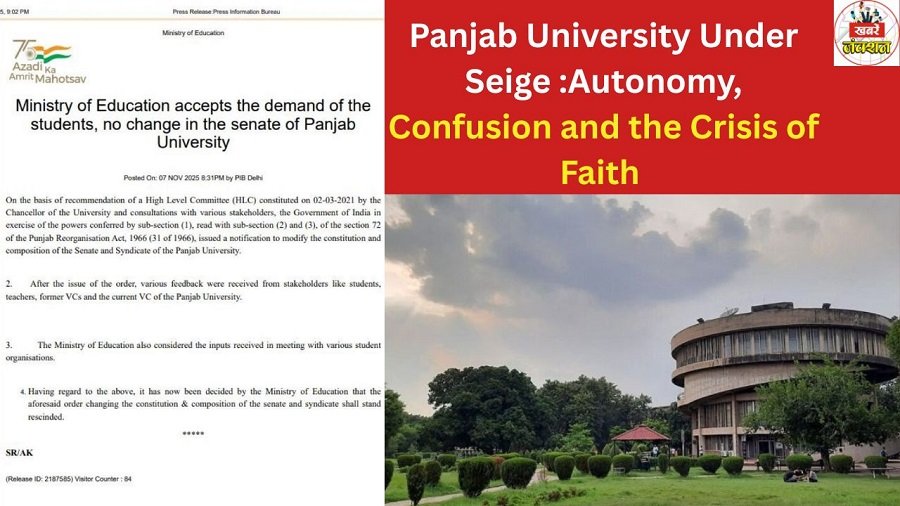
Strong protests by students and political parties has forced Union government to take U – turn on issue of removal of Senate and Syndicate of prestigious Punjab University Chandigarh and it has withdrawn its notification.Our enlightened reader Dr Ramesh K .Madaan .Academician and Political Scientist has examined its implications and motive behind the move.🇮🇳Panjab University Under Siege: Autonomy, Confusion, and the Crisis of Faith
🔷The Idea of a University — and the Erosion of its Autonomy-
Panjab University, Chandigarh — once a beacon of higher learning and democratic governance — now finds itself caught in a storm of confusion, illusion, and contradiction. The recent attempt to restructure its Senate and Syndicate has ignited a fierce debate about the meaning of autonomy and the future of university governance in India.
A single bureaucratic notification has turned into a flashpoint for academic, political, and constitutional contestation. What began as a so-called reform to “streamline governance” has now been widely perceived as an attack on the university’s independent and representative character — an intrusion into the soul of an institution that has long embodied Punjab’s intellectual and cultural identity.
🔷The Trigger: Reform or Retrenchment?
In late October 2025, the Central Government issued a notification proposing sweeping changes to Panjab University’s Senate — reducing its size drastically, removing several elected constituencies, and increasing the share of nominated and ex-officio members. Officials argued this was to “improve efficiency,” but the move came without prior consultation or legislative amendment to the Panjab University Act.
The backlash was immediate and fierce. Students and teachers rose in protest, political parties across ideologies condemned the step, and civil society stood united in defense of the university’s autonomy. Within days, the government was forced to step back — not out of generosity, but because public opinion and academic integrity refused to be silenced.
🔷Confusion and Contradiction: Reform in the Name of Control
The official narrative of “modernizing governance” hides a deeper contradiction. True reform strengthens participation, transparency, and accountability — it doesn’t replace elected representatives with nominated appointees. Reducing the democratic space within universities is not modernization; it is centralization disguised as efficiency.
The confusion lies in the way “autonomy” is being redefined — not as freedom from interference, but as obedience to authority. Universities thrive on open dialogue, debate, dissent, and diversity in democratic set up. When those are replaced with executive control and bureaucratic supervision, we risk converting centers of learning into administrative outposts.
🔷The Political Undercurrent: Federalism and Identity
Panjab University is not just another campus. It is a living institution of Punjab’s intellectual heritage, born out of post-partition resilience. Any unilateral change in its governance touches the very nerve of Punjab’s cultural autonomy and India’s federal spirit.
The outrage was not just academic; it was emotional and political. For the people of Punjab and Chandigarh, the Senate and Syndicate are not ornamental bodies — they are democratic forums where teachers, students, and alumni have a voice. Silencing that voice is seen as silencing the region itself.
🔷The Larger Question: What Kind of Universities Do We Want?
This crisis of Governance forces us to ask fundamental questions:
▶️Do we want universities that question, critique, and innovate — or ones that merely comply?
▶️Can education truly flourish under political pressure or bureaucratic control?
▶️Is efficiency worth the cost of intellectual freedom?
The answer lies in reviving trust, dialogue, and respect between governments and institutions. Academic reform must be participatory, not imposed; consultative, not coercive. Otherwise, every university will soon face the same uncertainty that Panjab University is enduring today.
🔷A Way Forward: Dialogue, Law, and Dignity
1.Transparent Consultation: The Centre and State must engage in open dialogue with teachers, students, and alumni before any structural reform.
2.Legal Clarity: The Panjab University Act should be revisited through legislative debate — not through executive orders.
3.Safeguarding Representation: Elected bodies must remain at the heart of university governance.
4.Federal Respect: Education, culture, and autonomy are shared xresponsibilities, not instruments of control.
🔷The Verdict of Consensus and Conscience
The episode at Panjab University is not an isolated conflict — it is a mirror to the nation’s evolving relationship with knowledge, power, and freedom. Universities are not factories of obedience; they are laboratories of democracy. When autonomy weakens, the republic itself becomes poorer.
For the youth of India — students, researchers, activists and thinkers — this is a moment of awakening. “Youth ki Aawaaz” must rise not only for jobs or reforms but also for academic freedom and institutional dignity. Because in protecting the autonomy of a university, we are, in truth, defending the autonomy of our own future.8 November,2025