
Indo–US Deal: A Curse or a Blessing for Indian Farmers? The Government’s Litmus Test
Gustakhi Maaf Haryana – Pawan Kumar Bansal
By our enlightened reader: Satish Mehra
Indo–US Deal: A Curse or a Blessing for Indian Farmers? The Government’s Litmus Test
The proposed ₹41 lakh crore (USD 500 billion) trade deal between India and the United States is being projected by the government as a historic opportunity. However, from farms to factories, it has already triggered intense debate across the country. When India’s total Union Budget stands at around ₹53.47 lakh crore, setting a bilateral trade target of nearly the same magnitude clearly indicates that this agreement is not merely about trade, but about reshaping the direction of India’s economy. The central question is whether this direction will benefit Indian farmers and domestic production—or harm them.
Under the proposed framework, the United States will supply India with a wide range of products, including fresh and processed fruits, walnuts, almonds, alcohol and spirits, animal feed, premium motorcycles, luxury cars, high-end clothing, leather goods, footwear, chemicals, home décor items, energy resources, aircraft, defence equipment, and advanced medical services. While these products primarily cater to India’s affluent consumer class, their ripple effects will be felt across domestic industries and among farmers whose markets and prices may be directly impacted.
Until last year, the United States was charging Indian goods an average tariff of nearly 50 percent. This included not only standard customs duties but also a 25 percent penalty tariff imposed because India was purchasing oil from Russia. Washington has now indicated that this tariff may be reduced to around 18 percent. The Indian government has termed this a diplomatic success. Critics, however, argue that imposing steep tariffs first and then offering partial relief amounts to pressure tactics rather than genuine free trade.
On India’s side too, tariffs on several American industrial and food products are expected to be reduced, despite official claims that sensitive sectors such as milk, cheese, and poultry will remain protected.
The most controversial aspect of the deal is the condition that if India continues to buy oil from Russia, the United States may reimpose the 25 percent penalty tariff. The Congress party and several farmer organisations argue that this threatens India’s energy security and foreign policy independence. They point out that countries like China and several European nations also import Russian oil, yet do not face similar penalties—raising serious questions about selective pressure on India.
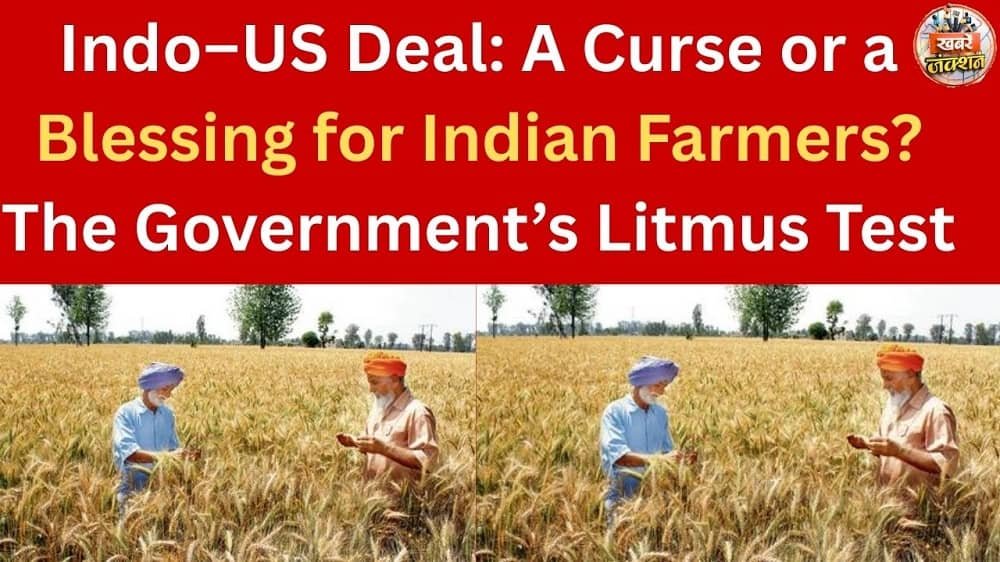
Farmer unions have announced large-scale protests, warning that even if wheat, rice, milk, and other staple products are currently protected, pressure will inevitably mount as the $500 billion trade target is pursued. American agriculture is heavily subsidised, and a large inflow of cheap US farm and dairy products could severely undermine India’s MSP-based farming system and jeopardise the livelihoods of millions of small and marginal farmers.
Commerce Minister Piyush Goyal has maintained that the agreement offers major opportunities for farmers and MSMEs and that sensitive agricultural and dairy sectors are fully safeguarded. The Ministry of External Affairs has also stated that farmers’ interests have not been compromised. According to the government, reduced tariffs will enhance the competitiveness of Indian pharmaceuticals, spices, tea, coffee, cashew nuts, and coconut oil in the vast American market, potentially boosting exports and rural incomes.
The Congress, however, describes the agreement as a “deal made under compulsion,” alleging that India has opened its markets under US pressure. It warns that imports from the US could rise sharply, converting India’s existing trade surplus into a deficit. There is also uncertainty regarding India’s IT and services exports, while Indian manufactured goods may continue to face relatively higher duties in the US compared to American goods entering India.
In the short term, some imported fruits, alcohol, machinery, and energy products may become cheaper, offering limited relief to consumers. But if domestic farmers and industries are weakened by unfair competition, the long-term consequences could include increased import dependence, job losses, and greater price volatility—ultimately harming the economy.
This $500 billion Indo–US trade deal could potentially elevate India’s role in global trade, but its true test will be in the fields of Indian farmers and the resilience of domestic industries. If sensitive crops, dairy sectors, and the MSP system remain firmly protected, the agreement could become a source of strength. If not, it risks turning into a serious threat to India’s agricultural and economic sovereignty.
That is why the government must ensure that, in the final agreement, the interests of farmers and key domestic sectors are fully safeguarded. If farmers are protected, this deal can be a blessing for India; even a small compromise, however, may turn it into a curse.
khabre junction