
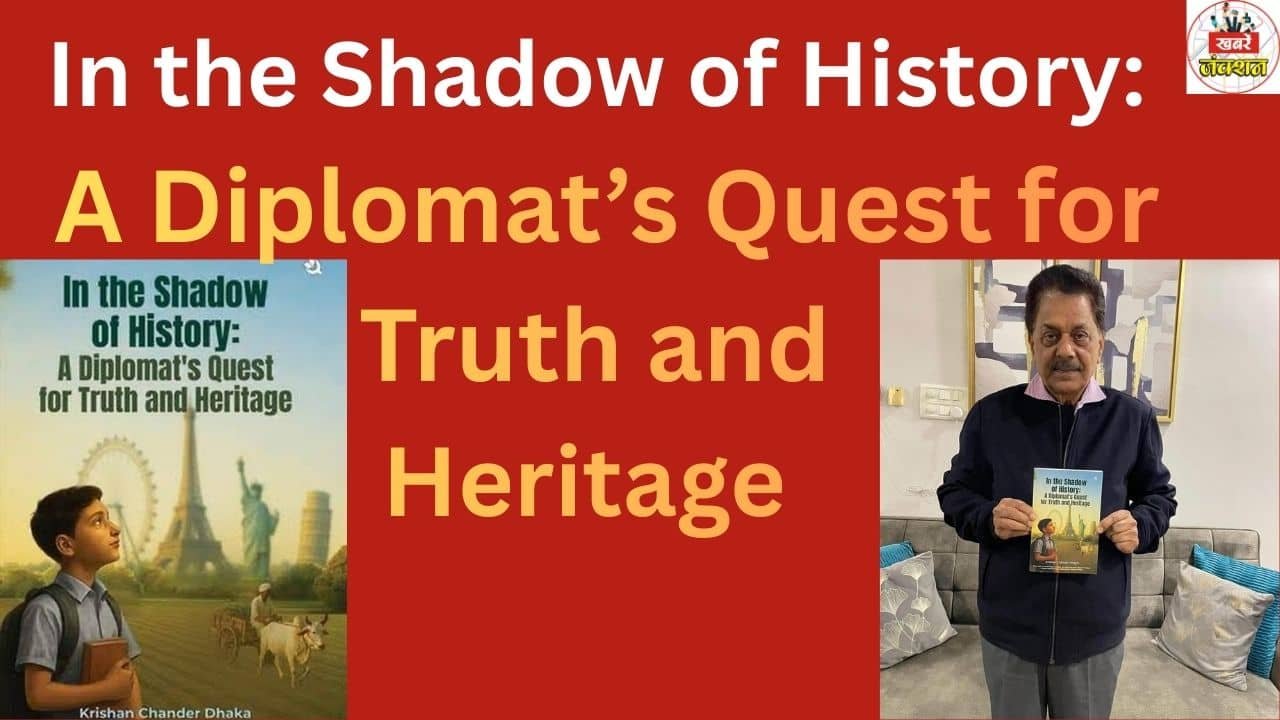
In the Shadow of History: A Diplomat’s Quest for Truth and Heritage
Gustakhi Maaf Haryana – Pawan Kumar Bansal
In the Shadow of History: A Diplomat’s Quest for Truth and Heritage
Book Review
Author: Krishan Chander Dhaka, Retired IFS
Publisher: Qurate Books, 2025
Genre: Memoir / Diplomatic and Historical Reflection
Length: Approximately 204 pages
Reviewed by: Enlightened reader Jaibhagwan Hooda
A Must-Read Book
In the Shadow of History: A Diplomat’s Quest for Truth and Heritage by Shri Krishan Chander Dhaka is a deeply reflective and intellectually engaging work that seamlessly blends personal memoir, diplomatic experience, and a broad interpretation of Indian history. The book stands at the intersection of individual journey and collective memory, offering readers not only an account of the author’s early life and professional career but also a profound exploration of India’s freedom struggle, the trauma of Partition, the historical evolution of the Jat community, and the contributions of visionary leaders who shaped modern India. It is both a personal narrative and a historical meditation, firmly rooted in truth-seeking and cultural pride.
Early Life: Foundations of Thought and Values
The book opens with an evocative account of Shri Krishan Chander Dhaka’s early life, set against the backdrop of rural North India, where tradition, community bonds, and historical consciousness deeply influenced his worldview. Raised in an environment that valued honesty, discipline, and social responsibility, Dhaka reflects on how family elders, local customs, and stories of resistance against injustice shaped his moral compass. These formative experiences instilled in him a deep respect for heritage and a curiosity about history—not as a static record of the past, but as a living force that shapes identity and purpose.
His early exposure to narratives of India’s freedom movement, agrarian struggles, and community leadership created a natural bridge between personal growth and national history. This grounding becomes central to the book, as the author consistently emphasizes that personal integrity and public service are inseparable.
Career and Diplomatic Journey
A substantial portion of the book is devoted to Dhaka’s professional life, particularly his diplomatic career. Rather than portraying diplomacy as mere protocol or negotiation, he presents it as a moral and intellectual responsibility. According to Dhaka, diplomacy at its best is a quest for truth—truth about one’s own nation, about global power structures, and about historical injustices that continue to shape international relations.
Through insightful anecdotes from his service, the author highlights the challenges of representing India on global platforms while remaining faithful to its civilizational values. His overseas experiences deepen his appreciation of India’s pluralism, resilience, and cultural depth. Importantly, Dhaka uses his diplomatic lens to critique selective historical narratives and urges readers to question dominant versions of history that marginalize indigenous voices and local heroes.
Indian History and the Trauma of Partition
One of the most poignant sections of In the Shadow of History addresses Indian history during the colonial period and the Partition of India. Dhaka approaches Partition not merely as a political event but as a profound human tragedy that scarred generations. With great sensitivity, he writes about displacement, violence, and the enduring psychological wounds, particularly in Punjab, Haryana, and surrounding regions.
The author candidly examines the failures of colonial policies and political leadership that led to such immense suffering. At the same time, he highlights the resilience of ordinary people who rebuilt their lives despite unimaginable loss. In Dhaka’s narrative, Partition becomes a lasting lesson on the dangers of divisive politics and the essential need for unity grounded in mutual respect.
History of the Jats: Valour, Identity, and Contribution
A central theme of the book is the history of the Jat community, which Dhaka presents as a chronicle of courage, self-respect, and social reform. Tracing their roots through ancient and medieval periods, the author portrays the Jats as agrarian warriors, defenders of land, and champions of egalitarian values. He challenges stereotypes and simplistic portrayals, arguing that the Jat ethos has consistently emphasized dignity of labour, collective welfare, and resistance to oppression.
Dhaka firmly situates Jat history within the broader narrative of Indian civilization, demonstrating how leaders from the community contributed not only to regional politics but also to national movements. This section holds particular value for readers interested in social history, as it combines scholarly insight with lived experience.
Great Leaders and Their Legacy
The book pays thoughtful tribute to a remarkable array of leaders whose lives embodied service, sacrifice, and vision.
Raja Mahendra Pratap Singh is portrayed as a revolutionary internationalist and patriot who pursued India’s freedom through global alliances, admired for his progressive outlook and commitment to education and social reform.
Netaji Subhas Chandra Bose emerges as a symbol of uncompromising nationalism, with emphasis on his military strategy, ideological resolve, and extraordinary ability to inspire the masses.
Chaudhary Chottu Ram is celebrated as a messiah of farmers, whose legal and social reforms empowered peasants and challenged feudal exploitation.
Chaudhary Charan Singh is presented as a principled statesman and advocate of rural India, with insightful analysis of his vision for decentralized, farmer-centric development.
Chaudhary Devi Lal is remembered for his populist appeal and unwavering support for farmers and marginalized communities, while Kisan Keshari Baldev Ram Mirdha is acknowledged for his role in cooperative movements and rural upliftment.
Dr. Balram Jakhar, Dr. Sarup Singh, and Dr. Ramdhan Singh are portrayed as intellectual and political leaders who combined academic insight with grassroots engagement, strengthening parliamentary democracy, education, and social equity.
Through these portraits, the author weaves a collective narrative of leadership rooted in ethical conviction rather than personal ambition.
History as Responsibility
Ultimately, In the Shadow of History asserts that history is not merely about the past—it is a responsibility toward the future. Shri Krishan Chander Dhaka calls upon readers, especially younger generations, to engage critically with history, honour forgotten heroes, and uphold the values of justice, unity, and truth.
As a diplomatic quest for truth and heritage, the book succeeds in illuminating neglected dimensions of Indian history while powerfully reminding readers that personal integrity and collective memory are inseparable. It stands as a meaningful contribution to contemporary historical literature and a heartfelt tribute to India’s enduring spirit.