
Implications of suspension of “Indus water treaty” between India and Pakistan-Our talk with experts
Gustakhi Maaf Haryana- Pawan Kumar Bansal
After killing of innocent tourists by terrorists in Pahalgam, Government of India has suspended Indus-water treaty with Pakistan and downgraded diplomatic relations by reducing the mission- strength and closed Atari integrated check-post.On the other hand, Pakistan has threatened that any attempt to stop or diversion of flow of water will be treated as an “act of war.”
What is Indus-water treaty and the implications of its suspension and its international ramifications, reports ,we talked to some experts.
Immediately after the Pahalgam killings, a meeting of Cabinet Committee on Security chaired by the Prime Minister, took the above drastic decisions including putting on hold of Indus-water treaty.Foreign Secretary Vikram Misri said “The Indus Waters Treaty will be held in abeyance with immediate effect until Pakistan credibly and irrevocably abjures its support to cross-border terrorism “.Pakistan has even threatened to hold in abeyance the Shimla agreement peace treaty signed with India in 1972 adding that any attempt to divert or block its rightful share of river waters will be treated with “full force”.
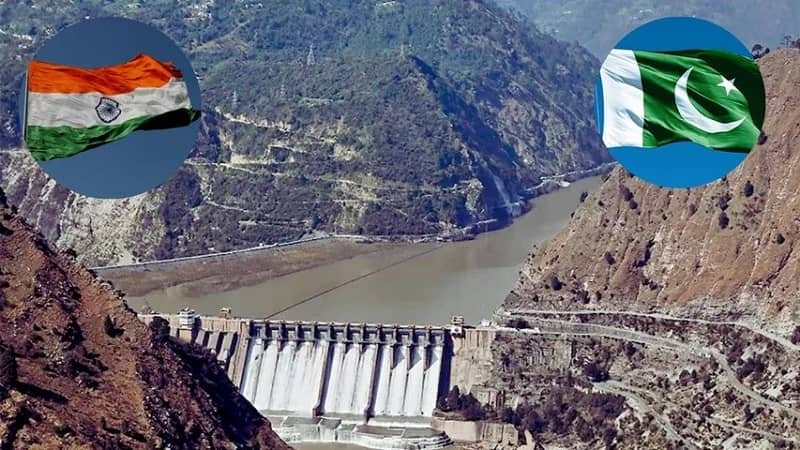
Indus- water treaty is a bilateral treaty between India and Pakistan signed between both the countries in 1960 for sharing the river- waters.
Pakistan has already threatened that suspension of treaty will be considered as an act of war and on the other hand Government of India claims that it is well within its rights to suspend the bilateral treaty.The treaty allocates the waters of the Sutlej, the Beas and the Ravi for 100 percent use by India and the use of water of three other rivers, the Indus,the Jhelum and Chenab for 100 percent use by Pakistan.
However, from these rivers India can use the run-off of the rivers to generate power but cannot store water.It is believed that if the treaty is permanently disbanded it will affect Pakistan.
Retired EIC,Irrigation, Haryana and ex- member of Delhi Jal board ,R.K.Garg.told “Since partition of the country in 1947 divided the Indus-basin, it became necessary to work out sharing of Indus waters between the two new dominions.
Despite having 34% catchment area on Indian side, India only asked for 25% of total waters.Sharing however was finally agreed as proposed by the World bank and the treaty signed in September, 1960.India, unfortunately accepted only about 19.25% of the Indus waters,leaving a major claim of 6 MAF of Chinab waters, a proposal which was under consideration even before the independence. Acceptance of Indus-treaty by India was certainly a case of misplaced large heartedness on the part of India and was at the cost of large arid areas of Haryana and Rajasthan having a legitimate right on these waters.”
It is believed that to boost his image at international forum, the then PM,Jawahar Lal Nehru had agreed to give more waters to Pakistan than their legitimate share.
Over the years infra-structure was built on various rivers of the system so as to meet the objectives of the treaty.
Abrogation of the treaty can only be meaningful if India plans and builds diversion infra-structure and storages particularly on Chenab. These are time- taking projects.
However, the very intent of the country to abrogate the treaty is welcome as a first step towards getting rightful shares of these river- waters.Shashi Shekhar former Secretary, Union Water Resources and currently an expert with the World Resources Institute said “India is well within its right to suspend the treaty and any bilateral agreement will work only as long as the two parties agree to continue with it,even though there is a clause for arbitration”.
Another expert Prakash Upadhyay retired faculty of IIT,Roorkee said “the suspension of the treaty would negatively impact Pakistan because it is down-stream of the entire system.
However, it depends on how India chooses to regulate the system now .”Pakistan is likely to raise the issue at all available international forums to discredit India.It will be interesting to watch as how Modi led government handles this crucial issue having international reunifications.