
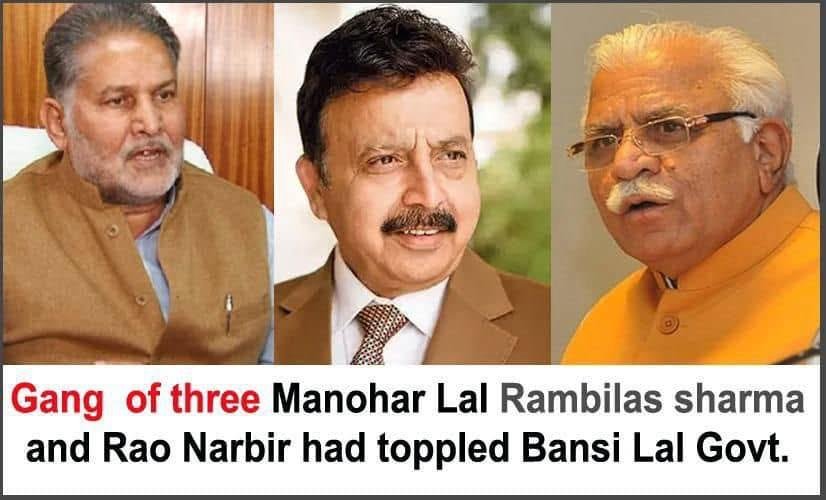
Gang of three Manohar Lal, Rambilas Sharma and Rao Narbir Singh with blessings of Atal Bihari Vajpayee had toppled Bansi Lal led Haryana Vikas Party and BJP,s government.
Gustakhi Maaf Haryana – Pawan Kumar Bansal
Bansi Lal Government Toppled
When the Haryana government led by Bansi Lal was toppled, it happened with the blessings of the then Prime Minister, Atal Bihari Vajpayee. These are extracts from my upcoming book on Politics, Culture and Governance of Haryana, “Murky Politics of Haryana”.
The whole country remembers former PM Atal Bihari Vajpayee for successfully running a rainbow coalition government. However, it is also a fact that a “trimurti” from Haryana played a key role in toppling the Haryana Vikas Party–BJP coalition government. This group included Manohar Lal Khattar, then organising secretary of Haryana BJP, Rao Narbir Singh and Rambilas Sharma. Their actions resulted in the installation of Om Parkash Chautala as Chief Minister.
Support and Helplessness
Senior leaders Lal Krishan Advani and Sushma Swaraj supported Bansi Lal. Despite their support, they could not prevent the fall of the government. Shockingly and shamefully, the script to topple the government was written and executed when the country was dealing with the aftermath of the Kargil battle.
Politics During Kargil
At a time when our jawans were sacrificing their lives in Kargil, the BJP toppled the Haryana Vikas Party–BJP coalition government headed by Bansi Lal. This was done with the blessings of Vajpayee and the support of disgruntled HVP MLAs.
Manohar Lal, Rao Narbir Singh and Rambilas Sharma formed a group of three. They became the main villains of this ugly political drama. Each of them had personal agendas against Bansi Lal. Disgruntled MLAs from his party also played a role, along with the blessings of Atal Bihari Vajpayee.
Background of the Alliance
In 1996, the HVP of Bansi Lal and the BJP contested the Assembly polls as pre-poll alliance partners. This alliance led to the formation of a government headed by Bansi Lal. The cabinet included nearly half a dozen BJP ministers.
After three years, Krishna Gehlot, Karan Dalal, Rao Narbir Singh and Brij Mohan Singla revolted against Bansi Lal’s style of functioning. BJP legislators supported them. This reduced the government to a minority and led to the formation of a new government headed by Om Parkash Chautala.
Vajpayee and Advani on Opposite Sides
The BJP high command remained sharply divided on the issue. Vajpayee supported the move, while L.K. Advani and Sushma Swaraj opposed it.
During the 1996 Assembly polls, Chautala was willing to align with the BJP. However, Sushma Swaraj ensured an alliance with Bansi Lal’s HVP. After becoming Chief Minister, Bansi Lal reciprocated the gesture by making Swaraj Kaushal a Rajya Sabha member from Haryana.
Personal Ambitions
Rambilas Sharma, who was a minister at the time, played a major role in the toppling of the government. He was eyeing the post of Chief Minister. A self-styled “godman” had reportedly told him that he had good chances of becoming CM.
Manohar Lal was also annoyed with Bansi Lal because he felt sidelined. Rao Narbir Singh was unhappy as well. His Food and Supplies portfolio was changed after a story published in Jansatta accused him of irregularities in the grant of brick-kiln licences and violation of environmental rules.
Because of these personal agendas, the trio worked together to bring down the government.
A Moral Question
Did our jawans die for this? Even the mules of Kargil were better than these new horses—defector MLAs of Haryana.
Shocked by this dirty game of horse trading, Akshya Gupta wrote a letter to the editor of The Tribune, a leading English daily published from Chandigarh. He expressed deep pain over the political developments.
He wrote that anyone with a conscience would feel ashamed to see horse trading at a time when the nation was mourning the loss of soldiers. He questioned whether these were the people for whom jawans made supreme sacrifices. He also asked what kind of role models such politicians were setting for the youth.
In his words, even the mules of Kargil were better than the new horses of the new government.