
CEC IMPEACHMENT: IS IT JUSTIFIED?
Gustakhi Maaf Haryana – Pawan Kumar Bansal
By our enlightened reader Ashok Lavasa, ex Election Commissioner of India
A win-win situation benefits all stakeholders even if a compromise is reached in search of a workable alternative. It could even be a way in which the winning side successfully deludes the losing side to perceive its loss as a necessary price it paid for survival. The win-win phrase has no antonym, although the exact opposite would be the one in which both sides lose without anything to compensate for their losses.
The impeachment motion of the Opposition parties against the Chief Election Commissioner (CEC) is one such example. It is a motion destined not to be carried. Yet its prime movers may not see the loss as defeat. But can the CEC see their loss as his victory?
The move of the Opposition parties doubtless is dramatic, even desperate. The question that needs to be pondered by the well-wishers of this constitutional body is what prompted them to don the gloves for a fight with no chance of victory. Perhaps, sometimes one fights not to win but to wound the opponent.
The troubling part is that the political parties treat the CEC as an opponent. That raises disturbing questions both parties must answer. The move to impeach the CEC is a first in the history of an institution that is a vanguard of Indian electoral democracy and was genuinely hailed as its custodian till the other day.
“India built many institutions after attaining freedom and adopting a Republican constitution… If anyone were to conduct an opinion poll on which of these institutions rendered the best service to Indian democracy with the highest degree of integrity, I have no doubt that the ECI will be our people’s first choice.”
That was Atal Bihari Vajpayee, the then Prime Minister, speaking at the ECI’s golden jubilee celebrations on 17 January 2001.
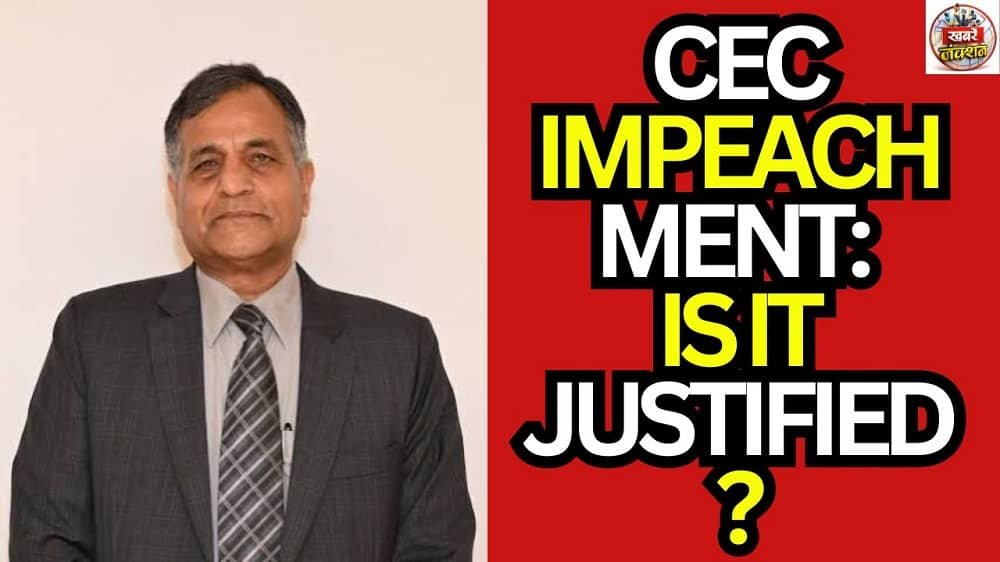
25 years later, 193 parliamentarians of the Opposition parties submitted notices for an impeachment motion against the CEC citing charges of “partisan and discriminatory conduct” and “obstruction of investigation into electoral fraud” and Special Intensive Revision of electoral rolls.
The notice is as unprecedented as the manner in which the revision of electoral rolls has been undertaken despite serious challenge by most political parties except the ruling dispensation. That unusual alignment of thinking disconcerted the opposition parties, which sharpened their attack against the CEC. The repeated press conferences of the Leader of the Opposition (LOP), exposing discrepancies in the electoral rolls of states where elections had been held, further soured the relationship.
The aggressive style and the severity of the LOP’s attack was surprising, for never in recent memory had someone as eminent as the LOP targeted the poll body questioning its integrity. But more surprising was the poll body’s obduracy in not providing a credible response to the doubts raised on its functioning and impartiality. Even as the attacks became bitter, the communication channels between the poll body and the opposition political parties seemed to choke.
The nation had seldom seen such a relentless campaign against the CEC, who stood his ground as the Supreme Court endlessly heard petitions against his decisions. As the petitions failed to yield any substantive relief, frustration mounted and so did the CEC’s apparent indifference, resulting in a virtual breakdown. The CEC persisted with the SIR despite the fortnight-long Vote Adhikar Yatra just before the Bihar state elections. Defiance seemed to define the relationship between the players and the referee.
Not that there was no dialogue. The one between the poll body and the Trinamool Congress caused more rancour, culminating in the theatrical presence of Mamata Banerjee in the Supreme Court. Never before had a Chief Minister appeared in the court arguing against the ECI’s unfair decisions. The dharnas against the SIR in West Bengal, or the number of officials dying in the course of conducting the revision, failed to deter the CEC or change his avowed commitment to “purify” the electoral rolls.
It was unprecedented for the poll body to treat exclusion, rather than inclusion, as the parameter of its success in “not leaving any voter behind.” The ECI invented the ‘logical discrepancy’ tool that pitted the electors against the artificial intelligence of algorithms used to detect discrepancies. A poll body that refused to explain the discrepancies publicly pointed out by the LOP after analysing its data now questioned the presence of electors in the rolls prepared as per its own due process.
West Bengal saw 58,20,899 electors deleted at the draft stage and 60,06,675 “under adjudication” in the final list. Never before has the ECI announced elections in a state with the fate of nearly ten percent electors undetermined. It employed micro-observers for finalizing the revised rolls, something never done in the past, and the Supreme Court took t
he unusual step of appointing about 500 judicial officers to decide the fate of these electors in a short span.
It is unusual for a constitutional body mandated with electoral rolls preparation to involve another constitutional body in discharging its routine function, disregarding the elector’s voting right it was created to protect. The exclusion of even a single eligible voter due to the way SIR has been conducted would legitimize the criticism of this arbitrary, ambitious and aggressive exercise.
However, does all this justify the impeachment move?
The answer depends on which side of the divide one stands. The crores of voters who figure in the final electoral roll might not protest, treating the tension and trauma during the revision process as part of the routine struggle that helpless citizens go through to secure their rights. The voice of those excluded doesn’t count in the elections in any case.
Eventually, the valid concern of protecting the right to vote turns into the lament of losers left with no choice but resorting ineffectively to the ultimate constitutional weapon against the CEC. The impeachment debate might be yet another phantasmagoria like the one on electoral reforms in the last parliament session.
Meanwhile, the ECI has sounded the poll bugle, asking the players to contest against each other rather than expend their energy against the referee. The ECI is now in full control. The successful completion of the poll process will justify all its decisions. Victors will exult; losers will find reasons to complain.
What the nation would be left with will be a bruised poll body in which a battered opposition, representing more than half the voting population, expressed no confidence.