
Robotic Demonstration Controversy: Who Is Responsible—A Lapse by Galgotias University or Government Haste?
Gustakhi Maaf Haryana – Pawan Kumar Bansal
By our enlightened reader Satish Mehra
Robotic Demonstration Controversy: Who Is Responsible—A Lapse by Galgotias University or Government Haste?
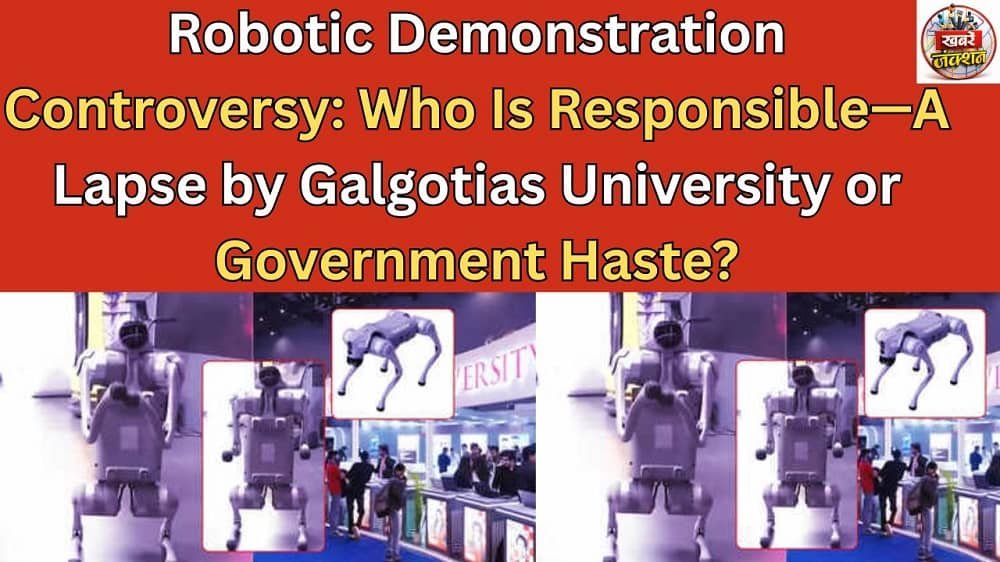
A robotic model presented at the International Robotics and Artificial Intelligence Conference held in New Delhi has raised serious questions about India’s technological credibility, institutional accountability, and government verification mechanisms. The robot showcased on stage was presented as a symbol of India’s indigenous technological capability and described as a significant achievement in the country’s innovation journey. Union IT Minister Ashwini Vaishnaw also praised the technology, calling it an example of India’s growing technological strength. The message conveyed at the time was clear: India was no longer merely a consumer of technology but had emerged as a creator and innovator.
However, as technical analysis of the model emerged, several experts indicated that the robot was not fully autonomous and was likely operating through external control or pre-programmed instructions. This raised a critical question—was proper technical verification conducted before presenting this technology as a national achievement? The controversy extended beyond a single model and brought into question the entire process through which a university-level experiment is elevated to a national platform.
Understanding the patent and technical authentication process is crucial in this context. In India, the legal authority to grant patents for any new technology, machine, or model lies solely with the Indian Patent Office, which functions under the Department for Promotion of Industry and Internal Trade. This institution determines whether a technology is genuinely new, original, and useful. Until a model is granted a patent, it cannot be considered a fully authenticated indigenous innovation in legal terms. If the robotic model in question had not yet received a patent or if its application was still pending, presenting it as a national technological breakthrough could be seen as premature from a procedural standpoint.
At the university level, there is also a defined process. When a student or researcher develops a new model, it is first examined by the university’s Research and Development or Intellectual Property Rights cell. Following this, a patent application is prepared and submitted to the patent office, where technical experts conduct a detailed evaluation. Only if the model meets all technical and legal criteria is a patent granted. This patent serves as legal proof of originality and ownership. Therefore, it is essential to clarify whether the model had received patent protection or official technical validation.
At the government level, there is a separate verification framework. When a technology is presented as a national achievement, institutions such as the Ministry of Electronics and Information Technology and the Department of Science and Technology typically conduct technical assessments and validation. If such verification was not completed and the model was accepted based solely on institutional claims, it would reflect a serious lapse in institutional coordination. This raises a broader question—was the responsibility limited to the university, or did government institutions also fail in their verification role?
The conference was inaugurated by Narendra Modi and attended by representatives, scientists, and technology experts from multiple countries. International platforms like these are not merely venues for technological demonstrations but represent a nation’s credibility and scientific standing. Every technology presented on such stages symbolizes the country’s innovation capability. Any discrepancy, therefore, affects not just a single institution but the nation’s global reputation.
This controversy has emerged at a time when India is actively positioning itself as a global technological power. The country has achieved remarkable success in digital payments, space exploration, software development, and the startup ecosystem. Indian scientists and engineers play key roles in leading global technology firms and research institutions. India is also making rapid progress in artificial intelligence, robotics, and machine learning. However, technological leadership is established not only through innovation but also through credibility and transparency.
As India moves toward becoming a technological superpower, it faces challenges related to energy resources, water security, research investment, and institutional transparency. Addressing these challenges requires that every technological achievement be presented only after thorough verification and authentication. If a technology is showcased without proper validation, it risks undermining public trust and institutional credibility.
Ultimately, this controversy is not merely about a robotic model but about the integrity of the system that recognizes an
d promotes innovation. If the demonstration was only a university-level experiment, it should have been presented within that context. If it was promoted as a national achievement, then comprehensive technical verification was the responsibility of the relevant institutions. This incident serves as an important lesson that technological progress must be accompanied by transparency and accountability.
India possesses immense talent, resources, and potential. The key requirement is to ensure that every achievement is presented with authenticity and integrity. This approach will not only strengthen India technologically but also establish it as a credible and respected global leader in innovation.
khabre junction