
From the FB Wall of Jagtar Singh, Veteran Journalist and Senior Colleague, Indian Express: Strategic Polarisation by BJP Has the Potential to Disrupt Social Secularism in Punjab
Gustakhi Maaf Haryana- Pawan Kumar Bansal.
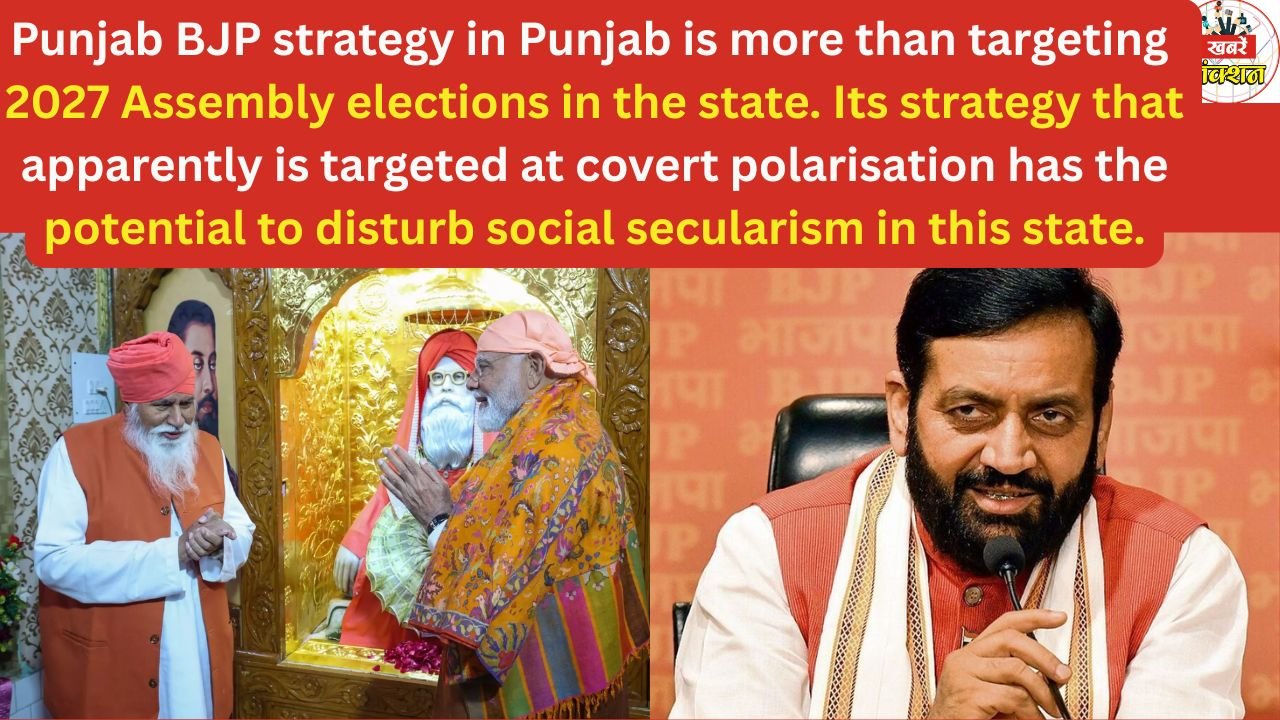
Punjab BJP strategy in Punjab is more than targeting 2027 Assembly elections in the state. Its strategy that apparently is targeted at covert polarisation has the potential to disturb social secularism in this state.
From FB wall of Jagtar Singh veteran journalist and my senior colleague in Indian Express.Strategic polarisation by BJP has potential to dislocate social secularism in Punjab
Prime Minister Narendra Modi’s recent visit to Dera Sachkhand Ballan in the Doaba heartland—an area where Dalit social and religious formations wield considerable influence—has once again revived the debate on the role of deras in Punjab’s complex religio-political landscape. Punjab, a border state that has historically witnessed alternating cycles of violent and remarkably peaceful mobilisations over more than a century, continues to remain politically sensitive and socially layered.
This is typical Punjab whose political discourse has invariably been dictated by the Sikh religio-political discourse, at least till recently. This dominant Panthic religio-political discourse has now got fragmented over the period, thereby yielding space to new permutations and combinations in the state’s religio-political matrix. It can safely be said that Punjab is in a flux. The emergence of non-ideological Aam Aadmi Party is an example of the changing but sensitive landscape
At the beginning itself, it may also be emphasised that the social architecture of this otherwise sensitive border state has been characterised by what can be termed as social secularism. This is because of syncretic and humanistic content of the Sikh philosophy that is non-discriminatory, contrary to the deeply caste based social structure in this country. Arya Samaj, although this formation came into confrontation with the Sikh thought at a later stage, too emerged in this landscape propagating casteless society.
Reinforcing this logic of social secularism is the fact that when Sikhs were killed and burnt alive and their women raped in Delhi and several other places for days beginning November 1, 1984 following killing of prime minister Indira Gandhi, Punjabis exhibited total unity with not even a single case of disturbance.
Modi’s visit to Dera Ballan assumes all the more significance as Nayab Singh Saini, chief minister of neighbouring state of Haryana has of late been playing a pro-active role to reinforce the Bharatiya Janata Party agenda in Punjab with his frequent visits. Punjab is on priority list of the BJP. Electoral ambitions of the BJP could be just one dimension in this context.
Punjab is the state whose religio-political discourse is different from all other states as this is a state where a national minority is in majority and this democratic formation has been once the ruler of this land. The other state is Jammu and Kashmir but that that region is known for entirely different scenario at every level, including its handling by the centre.
It is the role of the deras in the electoral landscape of Punjab that needs to be addressed first. Is the role of the deras in dictating political fortunes of a party is a myth or reality?
The only dera that has been known for public intervention in the electoral process is the Dera Sacha Sauda that came into confrontation with the Panthic stream beginning 2007 after the Assembly election in February. This dera used to have its political wing for this purpose. Rather this is the only dera in Punjab and Haryana that is known to have a political wing.
This dera headquartered at Sirsa in Haryana is perceived to have a massive following in the areas of Malwa belt of Punjab bordering Haryana. After Sirsa, its next important branch is at Salabatpura in Bathinda district.
The first recorded intervention of this dera its support to the Congress in the February 2007 Assembly elections. The Congress failed to retain power, yielding place to Akali Dal-BJP combine.
There is yet another interesting of Harminder Singh Jassi who was the Congress candidate from Maur in Bathinda district in 2017 Assembly elections. Jassi happens to be brother-in-law of Dera Sacha Sauda chief Gurmeet Ram Rahim. He trailed at third place.
But then the issue if that of perception and this perception dangerously impacted the religio-political discourse associated with Bargari sacrilege of Guru Granth Sahib and the related issues.
In the shifting power games, the Dera Sacha Sauda offered to extend support to the Akali Dal in the 2009 Lok Sabha elections. “Ram Singh, chairman of the political wing of the Dera Sacha Sauda, threw a political bombshell by saying that the Dera Sacha Sauda was not averse to supporting the SAD in the forthcoming parliamentary elections. Ram Singh, who was speaking to media, said that he had toured Dera followers in Muktsar, Bathinda, Ferozepur, Sangrur, Moga and Patiala. He added that after taking their views, individually and in groups, he and the other seven members of the committee formed by him, had reached the conclusion that if need arises, the Dera would support the SAD.” (The Tribune, November 7, 2008). This has to be seen in the context of the earlier developments including directive from Akal Takht in May 2007 to the Sikhs to boycott this Dera at the social and political levels after pictures appeared in the media of Gurmeet Ram Rahim attired like 10th Sikh Guru, Guru Gobind Singh within weeks of the Akali Dal-BJP government coming to power in the state.
Several of the candidates cutting across party lines approached the Dera for support in the 2022 Assembly elections. The Sikh candidates among them were hauled up at Akal Takht for violating the 2007 directive.
Another dominant Dera in Punjab is the Beas headquartered Dera Radha Soami having its branches in several states. However, this Dera is not known to exhibit its political proclivity.
Dera Sachkhand Ballan is the latest to hit the headlines, although it has been in the news for more than a decade. This Dera has its main following among the Ravidasia community. This community is known to be better off among the Dalits who constitutes about 32 per cent of the population in Punjab, the highest amongst all the states in the country.
The Dalits, however, are not a monolithic vote bank, rather there is no monolithic vote bank per se in this sensitive state although its political discourse has been dictated by the functioning of the Sikh religio-political matrix. There are dominant but not monolithic vote banks.
The issue is why the BJP is attaching so much importance to this Dera. Finance Minister Nirmala Sitharaman while presenting the budget in Lok Sabha on February 1 referred to the 649th anniversary of Guru Ravidas falling on that day. Modi visited Dera Ballan a few hours later and spent a considerable time there. This importance has to be seen in the context that it was not a centenary function of Guru Ravidass.
It may be mentioned that earlier during the 350th anniversary commemoration of Martyrdom of Guru Tegh Bahadur, the Ninth Sikh Guru, Modi skipped the main function at Anandpur Sahib and rather marked his presence at the function organised by Haryana at Kurukshetra.
These developments signal the approach of the BJP in the context of forthcoming Assembly elections and also its ideological push. The BJP drive is perceived to be focusing on socio-cultural agenda rather than the religio-political. This push seems to have been framed by assigning an important role to Nayab Singh Saini. The thinking is that Punjab, Haryana and Himachal Pradesh are broadly part of the same socio-cultural landscape.
In this context, the approach followed by the BJP in Haryana by moibilising all the non-landowning sections could be replicated in Punjab. This dimension assumes all the more importance in the context of Panthic political discourse having got fragmented, and thus derailed. The strategy seems to be to consolidate BJP agenda among Dalits, Hindus and OBCs. However, both Dalits and OBCs include both Sikhs and Hindus.
Ironically, although the strategy is changing, the party is inducting Sikh leaders from other parties.
Punjab is unlike other Indian states. Its societal core remains sensitive, its political memory long, and its religio-political undercurrents powerful. As Punjab stands at the cusp of yet another electoral cycle, the BJP’s expanding intervention—and the growing prominence of deras—could shape a new chapter in the state’s evolving political tapestry.
The covert and strategic polarisation as being perceived to be resorted to by the BJP in this state with distinct religio-political architecture has the potential to disturb social secularism in Punjab.