
When Kiran Bedi was given marching orders of transfer from Chandigarh on insubordination charges
Gustakhi Maaf Haryana – Pawan Kumar Bansal
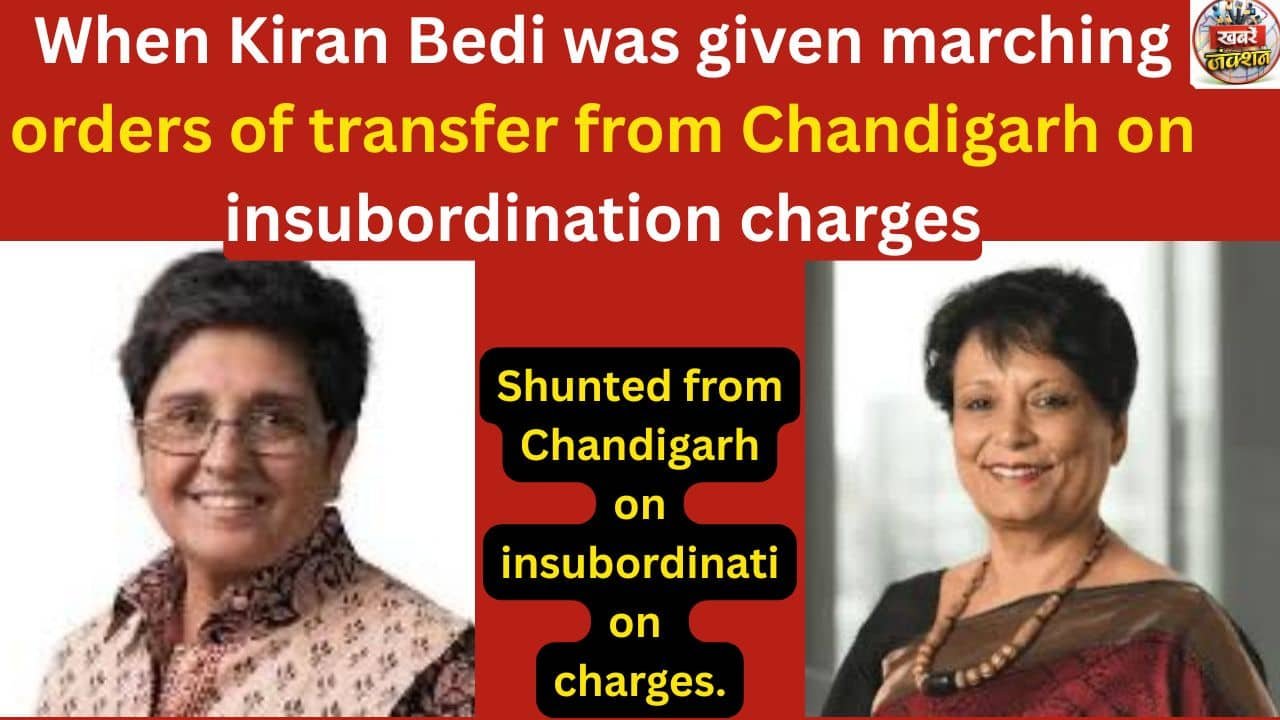
When Kiran Bedi was given marching orders of transfer from Chandigarh on charges of insubordination, she used to call former Delhi Chief Minister Arvind Kejriwal an anarchist who did not believe in the democratic functioning of government. However, she herself was reportedly given marching orders on charges of insubordination with seniors.
Although the then Chandigarh Home Secretary, Anuradha Gupta, with whom she had developed a confrontation on the issue of action against certain cops accused of murder, was also shifted from her post. Kiran Bedi was appointed Inspector General of Police, Chandigarh, in 1999. But after about one and a half months of her posting, the Union Home Ministry gave marching orders and she was shifted to her home state, Delhi. She was asked to relieve charge even before her successor was appointed, and Senior Superintendent of Police S. M. A. Farooqi, an Indian Police Service officer, was asked to take charge from her. Haryana cadre IAS officer N. K. Jain was appointed as Home Secretary.
The Union Home Ministry had ordered the transfers following a fight between the two officers over the powers of the Home Secretary and the city police chief. The row erupted after five police personnel, allegedly involved in a murder case in 1983–84, were suspended. Kiran Bedi questioned the authority of the Home Secretary in ordering the suspension of two Deputy Superintendents of Police and one Inspector. Kiran Bedi had even reportedly held a meeting of police officers and instigated them to raise their voice against the action of the Home Secretary. She accused the then Chandigarh Home Secretary Anuradha Gupta of bypassing her authority and even went to the extent of describing the action as a “rape of the police force”.
The Union Home Ministry took strong exception to Bedi’s stand, which “questioned the authority of her seniors in the administration” on the matter.
Bedi said she was never consulted before the police officers were suspended and that the inquiry was not routed through the IGP’s office or the police department. She even accused Anuradha Gupta of transferring even constables without her knowledge.
At that time, the Adviser to the Administrator reportedly wrote that the presence of Kiran Bedi in Chandigarh was not in public interest.
Home Secretary Anuradha Gupta denied all charges made by Bedi. At that time, the Chandigarh Administration issued a statement which was widely reported in the media. Referring to the statements of IGP Kiran Bedi that “rules were bypassed” and the IGP was made zero, the press release issued by the Chandigarh Administration described the allegations as incorrect. It further stated that Bedi’s contention that transfers in the police department were routinely made by the Home Department instead of the IGP was wrong and not based on facts, adding that the functional autonomy of the IGP was always maintained.
Referring to the allegations of Kiran Bedi that even constables and SHOs were transferred by the Home Department, it clarified that the administration was compelled to take action on the basis of inquiry reports which had established serious misconduct on the part of police officers cutting across ranks, pertaining to the false implication of three British nationals in a crime. Besides, the cops against whom action by Anuradha Gupta was questioned by Kiran Bedi were found indulging in serious irregularities and forgery in murder investigations and in a public brawl. The Home Secretary’s office, while referring to the action, stated that the State Government had the authority and was also duty-bound by law under the provisions of the Police Act and Punjab Police Rules framed thereunder to make interventions when it becomes absolutely necessary to avoid miscarriage of justice.